USM Haller Sideboard Alternative: Affordable & Compatible
A sideboard in the USM Haller style without the four-figure price tag: how to plan and configure a dimensionally identical sideboard from compatible parts — 60–70% cheaper, factory-direct, and expandable with the USM you already own.
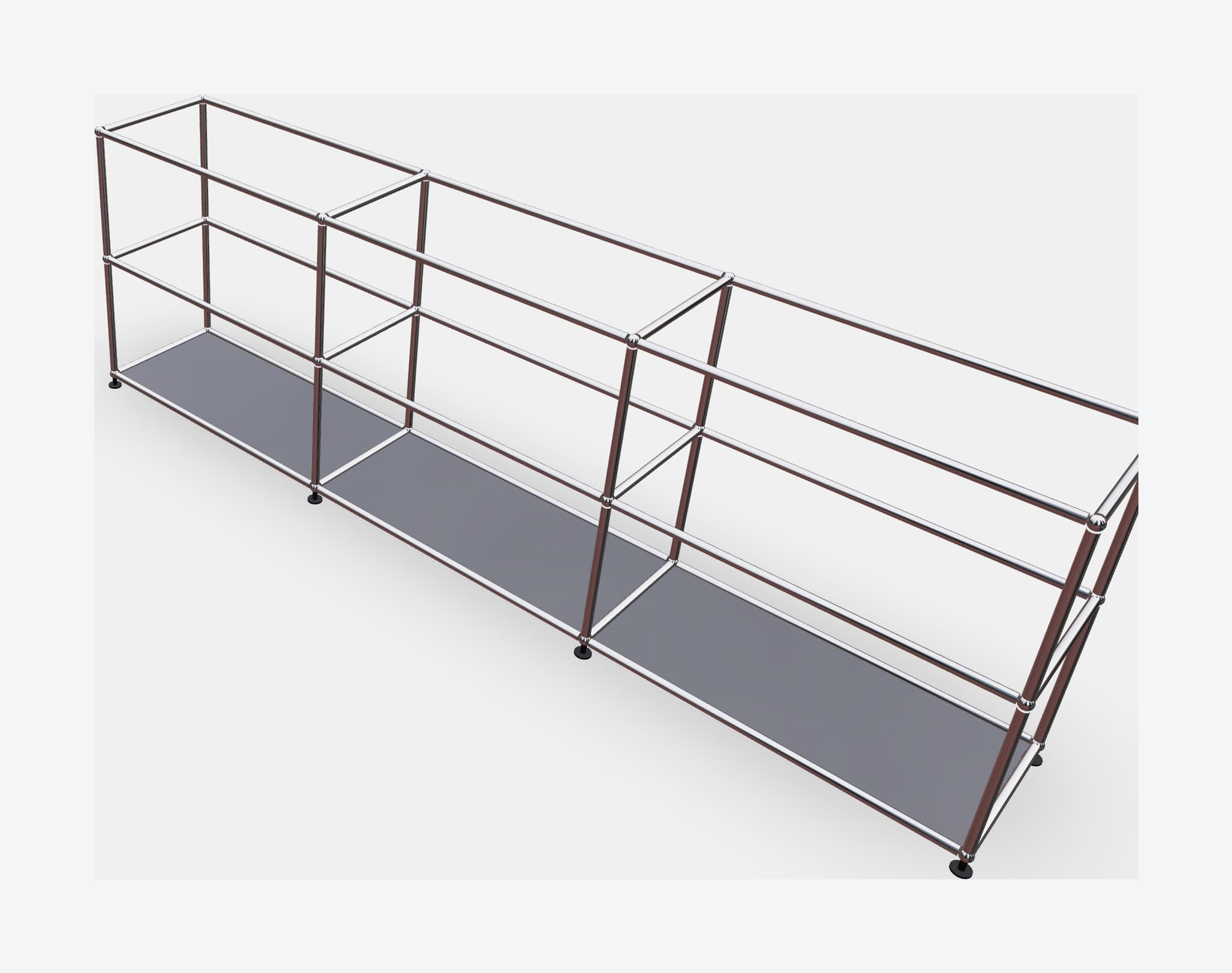
Ready to design an independent modular alternative?
Plan a Klackjoy unit around standard modular dimensions, then verify the exact configuration you need.
Try the free configuratorMade to order. Delivery time varies by destination; duties and taxes are included under DDP.
Compare the sideboard you would actually order
A useful USM Haller sideboard comparison starts with a configuration, not a saving percentage. Compare the finished width, height and depth, the number of doors or drawers, and what remains open. A closed two-bay cabinet and an open shelf of similar width are not the same purchase.
Check the item price in your selected currency, then review delivery and any applicable taxes for the actual destination. Also compare how the furniture arrives and which return terms apply to that order. Klackjoy is an independent brand and is not affiliated with USM.
Before choosing: Does the finished cabinet fit the space? Does it provide the fronts and storage you need? Can you accept the quoted total and delivery estimate?
Compare current configurations
Outside frame dimensions in mm, including connectors; feet and castors are excluded. Confirm the finished height before ordering.
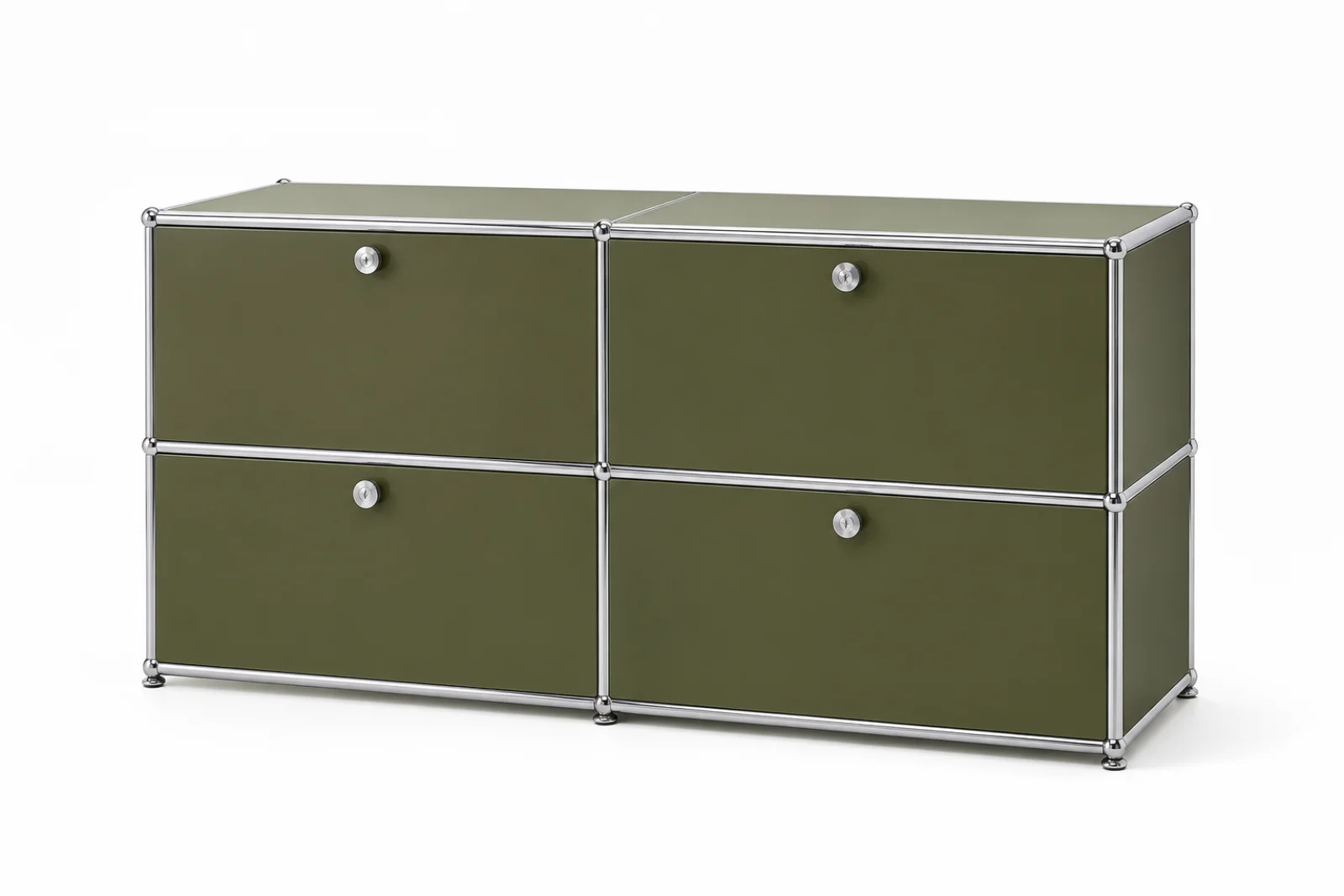
Mid-Century Olive Green Double-Row Sideboard — USM Haller Compatible
- Frame W × H × D
- 1525 × 725 × 375 mm
- Doors:
- 4
- Drawer fronts:
- 0
Configured item price: $988.81 (USD)
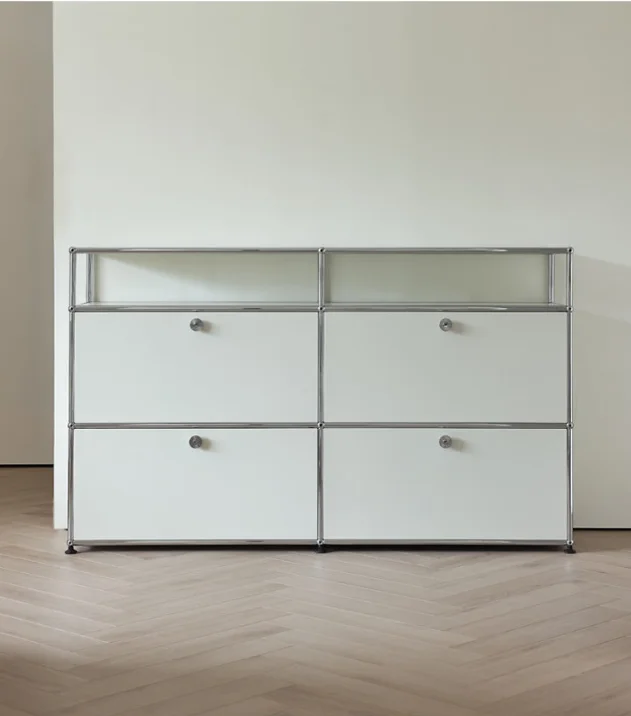
Milk-white modular sideboard in a modern minimalist style
- Frame W × H × D
- 1525 × 900 × 375 mm
- Doors:
- 4
- Drawer fronts:
- 0
Configured item price: $1,150.15 (USD)
Reference price in the currency shown, calculated from this design. Changes are repriced in 3D. Destination-specific delivery, taxes and final total are confirmed before payment.
The sideboard is the most sought-after form in the USM Haller universe — and also the one where the price stings the most. Anyone looking for a low, wide piece for the living or dining room quickly runs into the four-figure catalog prices of the original. This guide shows you how to plan, configure and affordably order a sideboard that looks and performs just like a USM Haller piece — using compatible parts that can even dock onto furniture you already own.
Why a sideboard in the USM Haller style is so popular
The USM Haller sideboard has become an icon because it brings together two things that rarely meet: strict, timeless geometry and genuine everyday usefulness. Its low, elongated silhouette slips under a window, tucks behind a sofa, or stands free in the middle of a room as a divider. The top becomes a continuous surface for a turntable, a lamp or a few vases, while records, files, dishes or toys disappear behind the doors.
It is exactly this versatility that makes the sideboard the most popular way into the modular system. Unlike a tall shelving unit, it stands free and is seen from every side — the chrome balls and the clean planes of color become a design feature in their own right. It is no surprise that so many people want precisely this one piece, yet balk at the purchase price.
This is where Klackjoy comes in. We manufacture USM Haller-compatible parts that physically match the original 1:1 and can therefore be combined into a full-fledged sideboard — roughly 60–70% cheaper than the catalog price. We take nothing away from the original: USM invented the classic and has perfected it over decades. We simply offer an affordable, compatible route to the same look. If you want to compare the different forms in general, our overview of USM Haller alternatives offers a broader perspective.
What a compatible sideboard has to get right
A sideboard is more than "a low shelf with doors." For a compatible piece to truly function and look like a USM Haller sideboard, several parts have to work together exactly.
The connecting ball is the heart of it all. At Klackjoy this is a 25 mm brass ball, chrome-plated, with an M8 thread — the very construction that defines the original. Only when the ball holds its dimensions and the M8 thread is right do the tubes seat cleanly and produce that familiar mirror shine.
The tubes form the skeleton. We use stainless steel tubes that join the balls into a stable, torsion-resistant frame. For a sideboard, it is mainly the short to medium lengths that matter, because the compartments are shallow and the depth is modest.
The surfaces turn the frame into furniture: powder-coated metal panels as back, side and bottom walls, plus — the defining sideboard feature — drop-down doors (fold-down flaps that open downward) or drawers. It is precisely these moving fronts that set the sideboard apart from an open shelving unit.
For the result to hold up in daily use, the details matter: flush-closing flaps, clean hinge movement, pull-out drawers with a proper stop. Klackjoy compatibility is documented at the 25 mm M8 connector interface and selected standard tube lengths; verify each existing part before combining systems. On the structure — the load-bearing ball-and-tube frame — we offer a 10-year warranty.
Planning dimensions: combining standard tube lengths
The most important planning step is the geometry, because the grid dimension determines both the look and the compatibility. All Klackjoy tubes follow the same standard lengths as the original — in millimeters, and identical for all three axes (width, height, depth):
100 · 150 · 175 · 250 · 350 · 395 · 500 · 595 · 750 mm
A sideboard takes shape as you combine these lengths into compartments. A few tried-and-true rules of thumb:
- Depth: Sideboards are shallow. In practice, most people reach for the 350 mm depth — deep enough for binders, dishes or records, shallow enough not to jut out into the room.
- Height: A single compartment gives you a very low bench-style sideboard. Stack two compartments (say, two times 350 mm) and you get the classic dresser height, at a comfortable level for setting things down.
- Width: This is where you set the overall impression. Two 750 mm compartments side by side make for a wide, calm sideboard; three compartments built from shorter lengths feel more rhythmic and offer more fronts for flaps and drawers.
Two terms help with the math. The nominal dimension matches the catalog measurement and, at the same time, the axis dimension (ball-center to ball-center). The overall dimension — the actual width or height of the finished piece — is the nominal dimension plus 25 mm, because a half-ball protrudes at each end. So anyone planning a sideboard to fit a niche or slot under a windowsill to the millimeter should always work with the overall dimension: nominal plus 25 mm.
Because the tube lengths correspond exactly to the original grid, the result fits with existing USM elements not just visually but physically — more on that below.
Choosing color: from classic to statement
Color decides whether your sideboard sits quietly in the room or becomes the focal point. Klackjoy offers the tones that define the USM Haller look. For the neutral and classic colors, you can orient yourself by the familiar RAL references:
- Pure White (RAL 9010) — the bestseller, bright and unobtrusive
- Light Grey (RAL 7035) and Middle Grey (RAL 7005) — calm greys for timeless restraint
- Anthracite Grey (RAL 7016) and Graphite Black (RAL 9011) — dark, graphic, elegant
- Golden Yellow (RAL 1004) and Pure Orange (RAL 2004) — the iconic signal colors for a real statement
- Steel Blue (RAL 5011) and Gentian Blue (RAL 5010) — deep blues with character
For a sideboard meant to serve as a quiet surface in the living room, white and the greys are usually the safe choice. If you want to set a deliberate accent, pair a neutral body with colored flaps — the front becomes a design element without making the piece feel busy. We go deeper into which color suits which room, and how combinations play out, in our color guide for USM Haller.
Price comparison: why 60–70% savings are realistic
Price is the main reason anyone looks for an alternative in the first place. A sideboard from the original can quickly climb into four figures, depending on size and the number of flaps. Compatible parts from Klackjoy typically come in 60–70% below that — for the same form and dimensionally identical components.
This is possible thanks to the direct-sales model: we ship factory-direct, without traditional furniture retail or showroom markups in between. You configure online, we manufacture and ship — the saved retail margin ends up with you instead of in the supply chain.
An honest framing matters here: "cheaper" does not mean "built differently" at Klackjoy. The ball remains a 25 mm brass ball with an M8 thread, the tubes remain stainless steel, the grid stays identical. The difference lies in the sales channel and the brand markup, not in a stripped-down construction.
Klackjoy is not the only supplier of compatible parts. Konektra and Limics24 also offer parts that fit the USM Haller system. Alongside them are systems like Flexcube, which is a standalone modular furniture system and is not compatible with USM Haller, as well as earlier budget promotions such as Tchibo CN3. Which supplier is right for you depends on range, availability and service — it is best to check the terms directly with each provider. We draw a direct comparison with one of the competitors in our article Konektra vs. USM Haller.
Configure it yourself: a few steps to your own sideboard
The fastest path from idea to finished piece runs through the 3D configurator. Instead of picking ready-made models from a catalog, you build your sideboard right on the screen — and see every change instantly in real time.
Here is how it typically goes:
- Set the base grid. Start with the depth (usually 350 mm) and the width. Place compartments side by side until you reach the total width you want — the configurator automatically works with the valid standard lengths.
- Build up the height. Stack one or two rows of compartments to go from a low bench to classic dresser height.
- Choose the fronts. Decide for each compartment whether it stays open or gets a drop-down door or drawer. This is where you set how much storage is concealed and how much structure stays visible.
- Assign color. Set a single continuous color, or add an accent with colored flaps.
- Review and order. The configurator shows the dimensions and the layout, so you can check the overall dimension against your available space before ordering through the shop.
Because the piece in the configurator is built from the same standard parts, everything you see is genuinely orderable and buildable — there are no "impossible" combinations that would not hold up in a real frame.
Docking onto existing USM: expand instead of buying new
One of the biggest practical advantages of compatible parts shows up if you already own USM Haller. Because the ball, thread and tube lengths correspond to the original grid, Klackjoy parts can be combined with existing USM — so you can expand a piece you already have instead of buying entirely new.
In concrete terms: you can extend an existing USM sideboard in width or height by adding compartments made from compatible tubes and balls. Or you can add flaps and panels to an open frame you already own. The new parts seat at the same ball points as the original — the transition, in assembly terms, is no different from continuing to build with original parts.
That makes compatible parts especially appealing for people whose needs have grown: a sideboard originally planned as a slim bench can, over the years, become a room-wide piece — without the USM you originally invested in becoming redundant. If you want to keep the chrome look and the colors consistent, simply match the same tube lengths and color tones as your existing piece when you buy more.
A low, clean sideboard is therefore often the ideal first step into the modular system: affordable to start with, expandable at any time, and fully compatible with whatever you may already own. You will find all the parts gathered in the Klackjoy shop at https://www.klackjoy.com.
Frequently Asked Questions
Is a Klackjoy sideboard really compatible with genuine USM Haller?
Yes, a Klackjoy sideboard is physically 1:1 compatible with USM Haller and can be freely combined with existing USM. The decisive dimensions are identical to the original: a 25 mm brass ball, chrome-plated, with an M8 thread as the connecting point, plus stainless steel tubes in the same standard lengths (100, 150, 175, 250, 350, 395, 500, 595 and 750 mm) for all three axes. As a result, the parts seat at exactly the same ball points as original components. You can therefore extend an existing USM sideboard in width or height, or add flaps and panels, without replacing the piece you already have. Klackjoy is a compatible third-party solution, not a USM product — but a precise fit to the system is the central design goal.
How much cheaper is a compatible sideboard?
A compatible sideboard from Klackjoy is typically 60–70% cheaper than the original's catalog price — for the same form and dimensionally identical components. This is made possible by factory-direct sales: there is no traditional furniture retail and no showroom markup between manufacturing and customer. You configure online and receive the piece directly, so the saved retail margin stays with you. It is important that "cheaper" does not mean "more simply built": the connecting ball remains a chrome-plated 25 mm brass ball with an M8 thread, the tubes remain stainless steel, and the grid dimension corresponds exactly to the original. The price difference comes from the sales channel and the brand markup, not from a reduced construction.
What are the dimensions of a typical USM Haller sideboard?
A typical sideboard is low and wide: it usually uses a depth of 350 mm, one or two stacked rows of compartments for its height, and several compartments set side by side across its width. The height and width come from the standard tube lengths (100 to 750 mm), which you combine freely. Two values matter for planning: the nominal dimension corresponds to the axis dimension from ball-center to ball-center, while the actual overall dimension of the finished piece is the nominal dimension plus 25 mm, because a half-ball protrudes at each end. So anyone planning a sideboard for a niche or under a windowsill should always work with the overall dimension. In the 3D configurator you see the resulting dimensions directly with every change.
What material are the parts made of?
The parts are made of two core materials: a chrome-plated brass ball as the connecting point and stainless steel tubes as the load-bearing frame. The ball has a diameter of 25 mm and an M8 thread into which the tubes seat — from this comes the familiar, mirror-like ball-and-tube frame. The surfaces — back, side and bottom walls, along with the drop-down doors and drawers — are powder-coated metal panels available in the classic USM color tones, such as Pure White (RAL 9010), Anthracite Grey (RAL 7016) or the iconic signal colors like Golden Yellow (RAL 1004). On the load-bearing structure, meaning the ball-and-tube frame, Klackjoy offers a 10-year warranty. That makes the sideboard built for longevity not just visually, but structurally as well.
Can I expand an existing USM sideboard instead of buying new?
Yes, you can expand an existing USM sideboard with compatible Klackjoy parts instead of buying an entirely new piece. Because the ball, M8 thread and tube lengths correspond exactly to the original grid, new compartments, flaps or panels dock at the same ball points as original components. In practice, that means you extend your sideboard in width or height, add extra flaps, or retrofit open compartments — the assembly is no different from continuing to build with original parts. This is especially worthwhile if your space needs have grown over the years: the USM you originally invested in remains fully usable. When buying more, simply match the same tube lengths and color tones as your existing piece so the look and the grid stay consistent.
Shop the Klackjoy modular system

Read next
Ready to design an independent modular alternative?
Plan a Klackjoy unit around standard modular dimensions, then verify the exact configuration you need.
Try the free configurator