How to Reconfigure, Disassemble and Extend a USM Haller Unit
A USM Haller unit can be reconfigured, disassembled, extended and have individual panels replaced — without replacing the whole unit. Here's how the ball-and-tube system actually works, and how to extend it with compatible parts that cost 60-70% less.
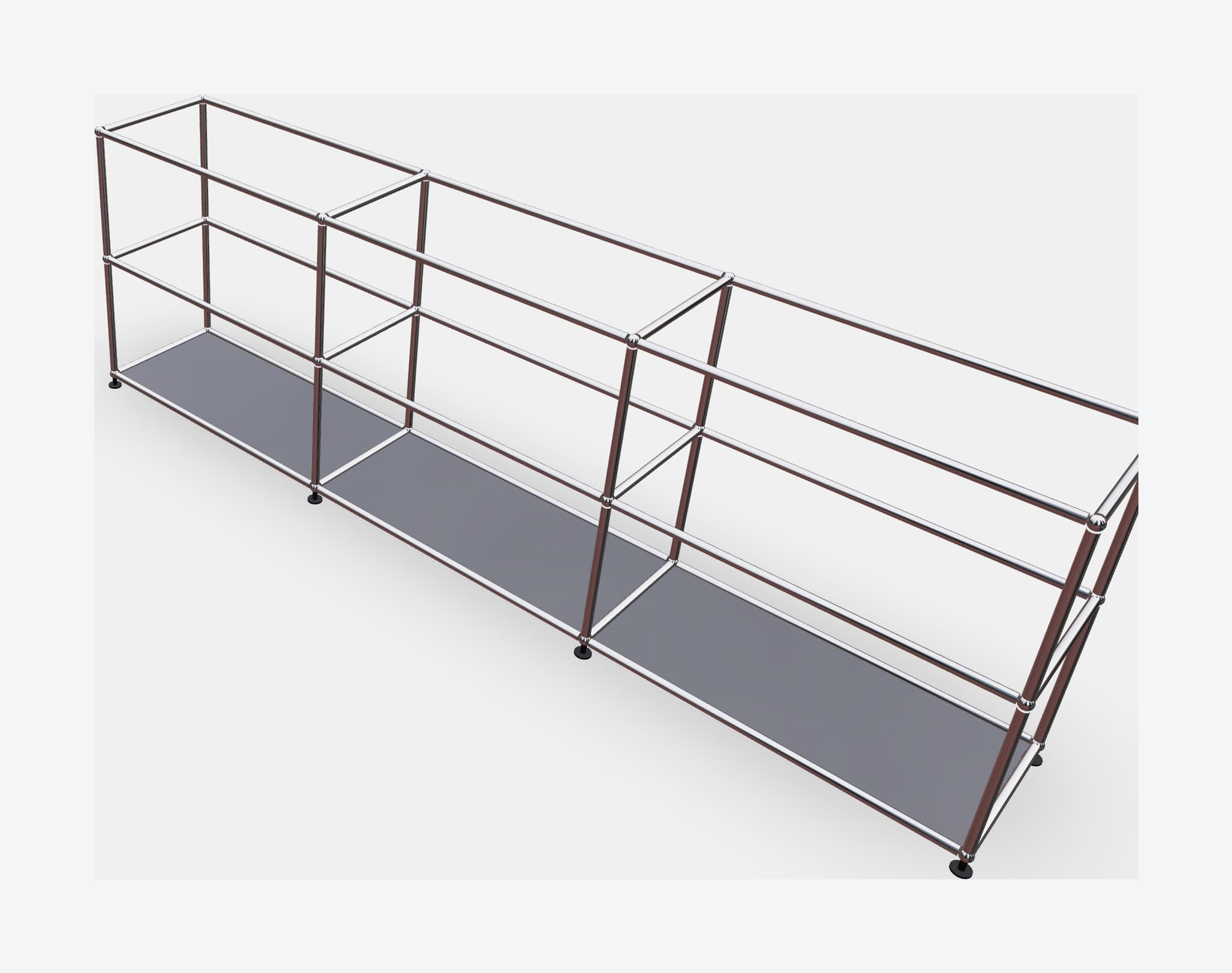
Ready to design your own modular furniture?
Use the free 3D configurator to plan a modular unit from the independent brand Klackjoy — choose size, color, and panels, and verify the exact compatibility requirements for your project.
Design your modular furnitureMade to order. Delivery time varies by destination; duties and taxes are included under DDP.
A shelving unit that moves house with you, grows with a new baby or a new job, and adapts to a completely different room without ever going to landfill — that's the actual promise behind a ball-and-tube furniture system, not a marketing line. Unlike a cabinet built from glued panels, a USM Haller unit is made from chrome-plated ball connectors, tubes and clip-in panels that were engineered from day one to be taken apart, rebuilt and rearranged as many times as your life changes. If you've ever moved apartments and realized your bookshelf simply doesn't fit the new living room, you know how rare that actually is in furniture. With USM Haller — and with physically compatible alternatives like Klackjoy — it isn't a workaround, it's the entire point of the design.
Can you really reconfigure a USM Haller unit?
Yes, and you don't need a workshop full of specialist tools to do it. The entire frame is built around 25 mm chrome-plated brass balls with an M8 thread, into which the tubes simply screw. There's no glue, no welding, and no permanent joint that only comes apart if you break something. Every connection is a screw connection, and every screw connection can be opened again with a matching hex key.
In practice, that means a low sideboard can become a taller shelving unit, a single unit can be split into two smaller pieces for two different rooms, and a corner configuration can be rebuilt into a straight run against a new wall after a move. The tubes themselves come in the standard USM catalog lengths — 100, 150, 175, 250, 350, 395, 500, 595 and 750 mm — and the same set of lengths applies to all three axes (width, height and depth). Reconfiguring a unit is mostly a matter of recombining the tube lengths you already own, or adding a few more where you're missing a size.
Part of why this works so well comes down to how the system was designed in the first place: there's no "left" or "right" ball, no front face that's screwed together differently from the back. Every node is identical, and every ball offers up to six possible connection directions. That's what makes the system durable in the long run, and genuinely future-proof — a piece of furniture that doesn't expire when you move out, but comes with you.
How do you disassemble a USM Haller unit, step by step?
Taking a unit apart follows a fairly simple sequence:
- Remove the panels first. Doors, drawers and shelves clip or hang into the tube frame rather than being glued in place. Most come out with a light pull or a bit of pressure — work from the top down and from the outside in, so the remaining structure stays stable while you're removing pieces.
- Unscrew the tubes. A hex key backs the tubes out of the ball connectors. Work systematically, level by level from the top, so the unit doesn't suddenly lose its balance partway through.
- Sort the tubes by axis as you go. Bundle and label (or just photograph) tubes of the same length and orientation — X, Y or Z — as you remove them. That single habit saves a lot of guesswork when you rebuild at the new location.
- Bag the balls and small parts separately. The ball connectors are small and easy to lose in a move — a resealable bag or small box per unit keeps them together.
- Photograph the original layout before you loosen the first screw. Two or three quick photos from different angles remove almost all of the guesswork when you're putting the unit back together somewhere new.
One thing worth knowing: the system is engineered for repeated reuse, not a single assembly. A unit that's already been rebuilt two or three times works exactly as reliably as it did on day one — the threads are rated for ongoing disassembly and reassembly, not a one-time build.
Can I replace just a single panel?
Yes — and this is one of the more practical advantages of an open, modular system over a closed furniture concept. Because every panel clips independently into the tube frame and isn't glued or clamped to its neighbors, you can swap out one bay without touching the rest of the unit.
Common reasons people do this:
- A door is scratched or damaged and needs replacing without buying an entirely new sideboard.
- The room's color scheme has changed (new flooring, a new wall color), and one or two bays need to match while the rest of the unit stays as it is.
- A closed door needs to become a drawer because how that bay gets used has changed.
- A bay should switch material entirely — say, from metal to wood or glass — to create a visual accent.
Because every single panel in the Klackjoy configurator has its own independent color and material field, you can order a replacement in exactly the size and color you need. That maps directly onto how you actually order parts in practice: a replacement panel gets ordered to spec, then clips into place at your next reconfiguration. That's not a given among USM-compatible sellers we've checked while building this comparison — some competitors only let you set a color for the entire unit, or at best per module, not per individual panel.
Can I extend my existing USM Haller unit with cheaper parts?
Yes — this is one of the practical reasons people look for an alternative like Klackjoy in the first place. Klackjoy parts are physically 1:1 compatible with genuine USM Haller: the same 25 mm chrome-plated brass ball connectors with an M8 thread, the same stainless steel tubes, and the same standard tube lengths (100/150/175/250/350/395/500/595/750 mm). If you already own a USM unit, you can extend it with Klackjoy tubes, balls and panels without introducing any visual or mechanical break in the system.
The price difference is significant: Klackjoy parts run roughly 60–70% cheaper than the USM original at the same physical compatibility. So if you want to add another level, a new module or a corner extension to a unit you already own, you don't necessarily have to buy at original prices to do it. The structural parts — tubes and balls — also carry a 10-year warranty.
Here's what that looks like in practice: build your existing configuration (or a new extension) in the configurator, bay by bay and tube by tube, using the same catalog dimensions as your original unit. For more on the mechanical fit itself, see USM Haller compatibility explained; for a side-by-side parts comparison, see USM Haller-compatible parts compared.
Do I need to replace the whole unit when my needs change?
No — and that's really the central point of this article. A modular ball-and-tube system like USM Haller is specifically built so your needs can change without the furniture having to go. If your family moves, a wide sideboard might become a narrower shelving unit for the new hallway. If a home office gets added, a few open bays might become closed doors for filing. If your taste shifts, a single-color unit might pick up a mix of two or three tones instead.
With conventional furniture made from MDF or solid wood, each of those changes usually means buying new and throwing the old piece away. With a ball-and-tube system, it means loosening a few screws, ordering the new or additional parts you need, and screwing it back together. That's not only cheaper — it's also more sustainable. A piece of furniture that grows with you over decades instead of being replaced generates a lot less waste than a string of brand-new purchases.
What should you prepare before a reconfiguration?
A few minutes of prep saves a lot of frustration later:
- Get the right tool ready. A matching hex key (usually included with your original order) is all you need for most tube-to-ball connections.
- Work out the new configuration's dimensions. How wide, tall and deep should the unit be at its new location? The configurator lets you test the new layout virtually before you touch a single screw on the real unit.
- Check which tube lengths you're missing. If you're extending rather than just rearranging, confirm ahead of time which of the nine standard lengths you'll need more of.
- Sort panels by material. If you're planning to switch materials on any bay, the guides on wood panels, glass doors and microfiber-leather panels cover what each option looks like.
- Clear enough space and lay down something soft. A blanket or rug protects both your floor and the chrome finish on the balls while you're working.
Switching doors and panels to a new material
A common reason for a partial reconfiguration is wanting to change what the front panels are made of — say, moving from a painted metal door to a wood front for a warmer look, or from a closed door to a glass one so the contents are visible. Because every panel clips in independently, that's technically no different from any other panel swap: old panel out, new panel of the same size in.
It's worth knowing up front how big the palette actually is for each material, so expectations stay realistic. Metal comes in 16 colors, including finishes from the classic RAL palette — nine of which carry an officially confirmed RAL code — plus two metallic finishes (brass and brushed aluminum). Microfiber leather (a superfine, faux-leather composite — not genuine hide) comes in 19 colors. Wood is currently available in one finish, Black Oak. Glass comes in two options, clear and frosted. Note that the frame's structural tubes are stainless steel, but that's a structural material, not a selectable panel surface finish — there's no stainless-steel panel option among the front materials.
If you're after a color that isn't in the standard palette, you can reach out to our team directly for a bespoke color — by email or WhatsApp — and we'll evaluate the request and, where it's a good fit, add the new color code to the catalog on the back end. It's a manual review, not an instant pick from an unlimited color wheel in the configurator itself.
The material swap itself takes only a few minutes: release the old panel from the tube frame, slot the new one in at the same width and height, and you're done. No tools needed for the panel swap itself, no waiting, no glue to cure.
What you're left with is a piece of furniture that never locks itself into a single living situation. Whether it's a move, a renovation, a change in how a room gets used, or simply the urge for a new color scheme, a ball-and-tube system from USM or a physically compatible alternative like Klackjoy can always be rethought — without a brand-new unit ever landing in your cart.
Frequently Asked Questions
Can you really reconfigure a USM Haller unit?
Yes, and you don't need a workshop full of specialist tools to do it. The entire frame is built around 25 mm chrome-plated brass balls with an M8 thread, into which the tubes simply screw. There's no glue, no welding, and no permanent joint that only comes apart if you break something. Every connection is a screw connection, and every screw connection can be opened again with a matching hex key.
How do you disassemble a USM Haller unit, step by step?
Taking a unit apart follows a fairly simple sequence:
- Remove the panels first. Doors, drawers and shelves clip or hang into the tube frame rather than being glued in place. Most come out with a light pull or a bit of pressure — work from the top down and from the outside in, so the remaining structure stays stable while you're removing pieces.
- Unscrew the tubes. A hex key backs the tubes out of the ball connectors. Work systematically, level by level from the top, so the unit doesn't suddenly lose its balance partway through.
- Sort the tubes by axis as you go. Bundle and label (or just photograph) tubes of the same length and orientation — X, Y or Z — as you remove them. That single habit saves a lot of guesswork when you rebuild at the new location.
- Bag the balls and small parts separately. The ball connectors are small and easy to lose in a move — a resealable bag or small box per unit keeps them together.
- Photograph the original layout before you loosen the first screw. Two or three quick photos from different angles remove almost all of the guesswork when you're putting the unit back together somewhere new.
Can I replace just a single panel?
Yes — and this is one of the more practical advantages of an open, modular system over a closed furniture concept. Because every panel clips independently into the tube frame and isn't glued or clamped to its neighbors, you can swap out one bay without touching the rest of the unit.
Can I extend my existing USM Haller unit with cheaper parts?
Yes — this is one of the practical reasons people look for an alternative like Klackjoy in the first place. Klackjoy parts are physically 1:1 compatible with genuine USM Haller: the same 25 mm chrome-plated brass ball connectors with an M8 thread, the same stainless steel tubes, and the same standard tube lengths (100/150/175/250/350/395/500/595/750 mm). If you already own a USM unit, you can extend it with Klackjoy tubes, balls and panels without introducing any visual or mechanical break in the system.
The price difference is significant: Klackjoy parts run roughly 60–70% cheaper than the USM original at the same physical compatibility. So if you want to add another level, a new module or a corner extension to a unit you already own, you don't necessarily have to buy at original prices to do it. The structural parts — tubes and balls — also carry a 10-year warranty.
Do I need to replace the whole unit when my needs change?
No — and that's really the central point of this article. A modular ball-and-tube system like USM Haller is specifically built so your needs can change without the furniture having to go. If your family moves, a wide sideboard might become a narrower shelving unit for the new hallway. If a home office gets added, a few open bays might become closed doors for filing. If your taste shifts, a single-color unit might pick up a mix of two or three tones instead.
With conventional furniture made from MDF or solid wood, each of those changes usually means buying new and throwing the old piece away. With a ball-and-tube system, it means loosening a few screws, ordering the new or additional parts you need, and screwing it back together. That's not only cheaper — it's also more sustainable. A piece of furniture that grows with you over decades instead of being replaced generates a lot less waste than a string of brand-new purchases.
Shop the Klackjoy modular system

Read next
- USM Haller Room Divider: A Double-Sided Shelf Built to Your Exact OpeningA freestanding, double-sided USM Haller room divider zones an open-plan home while staying accessible from both sides. Klackjoy builds it to your exact width and height in a live 3D configurator.
- USM Haller Record Stand: A Cheaper Custom Hifi & Vinyl Setup
Ready to design your own modular furniture?
Use the free 3D configurator to plan a modular unit from the independent brand Klackjoy — choose size, color, and panels, and verify the exact compatibility requirements for your project.
Design your modular furniture