Why You Never Need a CAD or Revit File to Order Custom Furniture from Klackjoy
Most small interior design studios don't have an in-house CAD drafter, and outsourcing shop drawings adds cost, time, and miscommunication risk. Here's how Klackjoy's configurator eliminates that step entirely — your finished design is already the production spec.
Why You Never Need a CAD or Revit File to Order Custom Furniture from Klackjoy
If you run a small interior design studio, there's a good chance you don't have a dedicated CAD drafter on staff. Most boutique studios — two, three, five people — can't justify a full-time drafting hire, and that gap shows up at the worst possible moment: right when a client has approved a custom modular storage wall and a fabricator needs precise, unambiguous drawings to build it.
This is a real operational problem across the design industry, not something unique to any one workflow. And it's one of the main reasons Klackjoy built its 3D configurator to double as the production spec itself — no CAD file, no Revit model, no drafting handoff required. Here's the pain point in detail, and exactly how the alternative works.
The Small-Studio CAD Gap
Independent designers and small studios generally have two options when a project needs formal shop drawings: outsource to a freelance CAD drafter or a drafting service, or hire someone in-house.
Industry cost benchmarks commonly cited for outsourced CAD or shop-drawing work on a custom furniture project land in the $2,000–$4,000 per project range, and a full-time in-house CAD drafter's salary is commonly benchmarked at $50,000+ per year in many markets. These are general industry figures, not numbers Klackjoy has measured internally, but they explain why most small studios can't justify dedicated drafting resources for occasional custom work.
Outsourcing carries its own friction even before the price tag. A freelance drafter or drafting service has to be briefed on the design, given every dimension and finish note, and then looped back in for every revision round the client requests — and each round adds days or weeks while drawings go back and forth for approval before a fabricator can even quote the job. Hiring in-house solves the turnaround problem, but only if there's steady volume to justify the salary; a studio that does occasional custom pieces alongside off-the-shelf sourcing rarely has enough of that work to keep a drafting role busy year-round.
Either way, the underlying issue is the same: getting from "the client approved this design" to "the fabricator has what they need to build it" is its own cost center, separate from the furniture itself, and it's a cost most small studios structurally can't absorb on every project.
When Shop Drawings Get Lost in Translation
Even when a studio does have access to CAD support, shop drawings introduce a second, quieter risk: miscommunication between what was drawn and what gets built.
Shop drawings are a translation step between an approved design and what a fabricator builds, and every handoff is a place where a dimension, finish note, or revision can get lost. Industry sources tracking custom fabrication and millwork projects have put miscommunication-driven rework at roughly 26% of projects — a sourced industry estimate, not a Klackjoy-measured figure. A configurator-as-production-spec workflow removes that translation step because there's nothing left to misread between approval and manufacturing.
That 26% figure is worth sitting with for a moment. It doesn't mean the drafter or the fabricator did anything wrong — it means a drawing is, by nature, an interpretation of a design. It has to be read, measured, and re-modeled by someone at the fabrication end who wasn't in the room when the client made their choices. A dimension gets misread, a finish note gets missed, a late revision doesn't make it into the final drawing set — and the piece that comes back doesn't match what was actually approved. Shop drawings aren't a flawed idea; they're simply a translation step, and translation steps lose information. The fewer of them a workflow has, the fewer chances there are for something to go wrong between approval and delivery.
How It Actually Works at Klackjoy
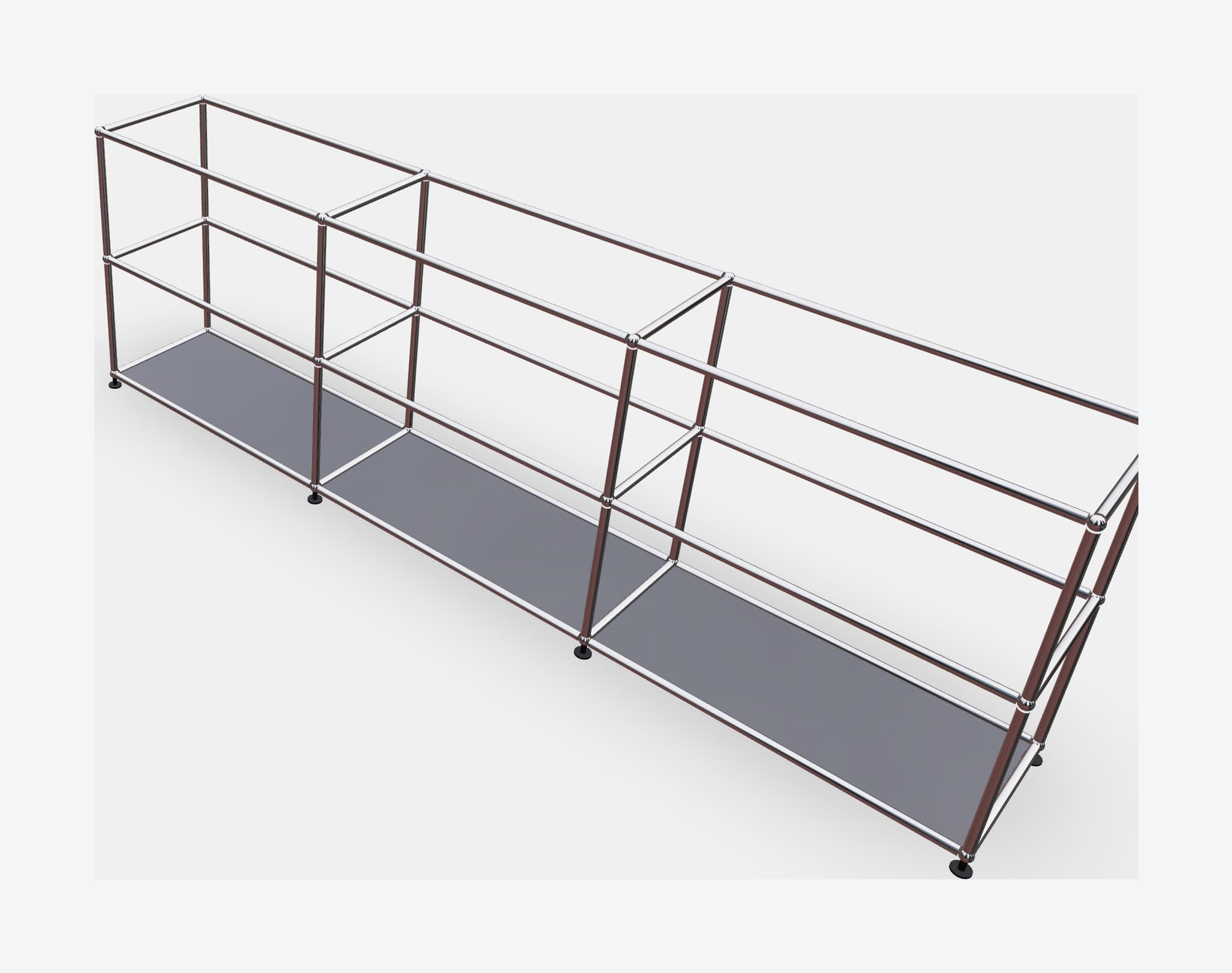
Klackjoy's configurator removes that translation step entirely, because there's nothing to translate. When you build a piece in the 3D configurator — placing nodes, tubes, and panels to construct a USM Haller-compatible unit — you aren't creating a representation of the final product. You're creating the final product's actual structural definition.
You never create or upload a CAD or Revit file — your finished configurator design is already the production spec. Every node, tube, and panel you place in the 3D configurator is stored as precise structural data, including exact USM-standard tube lengths and each panel's individual color and material. Our server reads that same data directly to calculate your price, so there's no separate drafting or file-conversion step between finishing your design and getting a quote.
There's no drafter re-interpreting your intent, no drawing set to proof against the 3D model, and no version-control problem between "the drawing" and "the design the client approved." If you or your client later want to make a change, you edit the configuration directly and the price and cut list update immediately from that same structure — with 50 steps of structural undo/redo if you need to backtrack through revisions.
When your design is complete, the server computes the price, bill of materials, and cut list directly from the same nodes/tubes/panels structure you built on screen — there is no intermediate hand-drawn or hand-modeled document anywhere in that chain, because the configurator design already is the production spec. This works identically for retail and trade customers; the only difference is account type and pricing tier, not a separate commercial drafting review stage.
What This Looks Like Compared to USM's Own Process
It's worth being precise here, because USM's own process isn't primitive — it's just built for a different workflow. USM offers real AutoCAD, SketchUp, and Revit downloads so that architects and designers can import Haller components into their own CAD or BIM software and work with them there, alongside the rest of a building or interior model.
That's a genuinely useful capability if your workflow is centered on a BIM environment and you need Haller geometry to live inside a larger architectural model. Klackjoy's difference isn't that CAD files are somehow a bad idea in general — it's that our ordering path doesn't require that step at all. You don't need to import anything into external software to get from design to manufacturing quote; the configurator itself carries enough precision to go straight to production. If your studio doesn't have CAD or BIM software or expertise in-house, that's one less piece of tooling you need to solve for on a Klackjoy order.
The Trade Program: Built for Designers Who Skip the File Step
For studios and architecture firms working with Klackjoy regularly, our trade program is worth applying for. Trade status is an application-based process — you submit your name, company, email, phone, website, business type, and a short message, and our team reviews it manually. Approved trade accounts get tiered discounts starting at 15% off retail, direct access to our design team, and expedited manufacturing, but discounts are issued as coupon codes after approval, not applied automatically at checkout.
To be clear about how this works: trade pricing isn't something that applies at checkout the moment you sign up. It's a manual review process, and there's currently no self-serve discount tier wired into the checkout flow itself — the coupon code arrives once a reviewer has actually looked at your application. If your studio does enough volume with USM-compatible modular furniture to make that worthwhile, applying costs nothing but a few minutes filling out the form.
Print-Ready Documentation, No PDF Pipeline Required
Once your design is finalized, you can generate a bill of materials and cut list directly from the configurator. This renders as an HTML view in your browser — to keep a copy for your records or hand to a fabrication partner, you print it or save it as a PDF through your browser's own print dialog. There's no separate PDF-generation system behind the scenes; the browser print function handles that step, and it's enough to produce a clean, shareable document without needing dedicated drafting or documentation software.
Getting Started
If your studio has been quietly avoiding custom modular pieces because you don't have CAD support on hand, that's exactly the gap this workflow is built to close. Build the piece in the configurator, get a price and cut list computed directly from your design, and — if you're ordering regularly — apply for trade status to get access to better pricing and a dedicated design contact. No drafter, no drawing set, no software to buy. The design you finish on screen is the order.
Frequently Asked Questions
Do I need to submit CAD or Revit files to get a custom quote?
You never create or upload a CAD or Revit file — your finished configurator design is already the production spec. Every node, tube, and panel you place in the 3D configurator is stored as precise structural data, including exact USM-standard tube lengths and each panel's individual color and material. Our server reads that same data directly to calculate your price, so there's no separate drafting or file-conversion step between finishing your design and getting a quote.
How does my configurator design become a production order?
When your design is complete, the server computes the price, bill of materials, and cut list directly from the same nodes/tubes/panels structure you built on screen — there is no intermediate hand-drawn or hand-modeled document anywhere in that chain, because the configurator design already is the production spec. This works identically for retail and trade customers; the only difference is account type and pricing tier, not a separate commercial drafting review stage.
Do trade accounts get automatic discount pricing?
Trade status is an application-based process — you submit your name, company, email, phone, website, business type, and a short message, and our team reviews it manually. Approved trade accounts get tiered discounts starting at 15% off retail, direct access to our design team, and expedited manufacturing, but discounts are issued as coupon codes after approval, not applied automatically at checkout.
How much does outsourcing CAD drafting typically cost a small studio?
Industry cost benchmarks commonly cited for outsourced CAD or shop-drawing work on a custom furniture project land in the $2,000–$4,000 per project range, and a full-time in-house CAD drafter's salary is commonly benchmarked at $50,000+ per year in many markets. These are general industry figures, not numbers Klackjoy has measured internally, but they explain why most small studios can't justify dedicated drafting resources for occasional custom work.
What's the risk with traditional shop-drawing workflows?
Shop drawings are a translation step between an approved design and what a fabricator builds, and every handoff is a place where a dimension, finish note, or revision can get lost. Industry sources tracking custom fabrication and millwork projects have put miscommunication-driven rework at roughly 26% of projects — a sourced industry estimate, not a Klackjoy-measured figure. A configurator-as-production-spec workflow removes that translation step because there's nothing left to misread between approval and manufacturing.
Shop the Klackjoy modular system

Read next
- The USM Haller Changing Table That Grows With Your ChildA modular changing table that unbolts and rebuilds into toy storage, then a kids' desk and shelving — one USM-compatible frame that spans the whole nursery-to-schoolroom journey. Buy once, reconfigure for years.
- USM Haller Record Stand: A Cheaper Custom Hifi & Vinyl Setup
Ready to design your own modular furniture?
Use the free 3D configurator to plan a modular unit from the independent brand Klackjoy — choose size, color, and panels, and verify the exact compatibility requirements for your project.
Design your modular furniture