USM Haller Mixed Color Configurator: Panel-by-Panel Color, Not Just Preset Combos
Most furniture configurators — USM's own Mix & Match line included — apply color at the level of the whole unit or a preset combo. Klackjoy's configurator assigns color and material to every single panel, door, and drawer independently, letting you mix metal, microfiber leather, wood, and glass finishes freely across one piece.
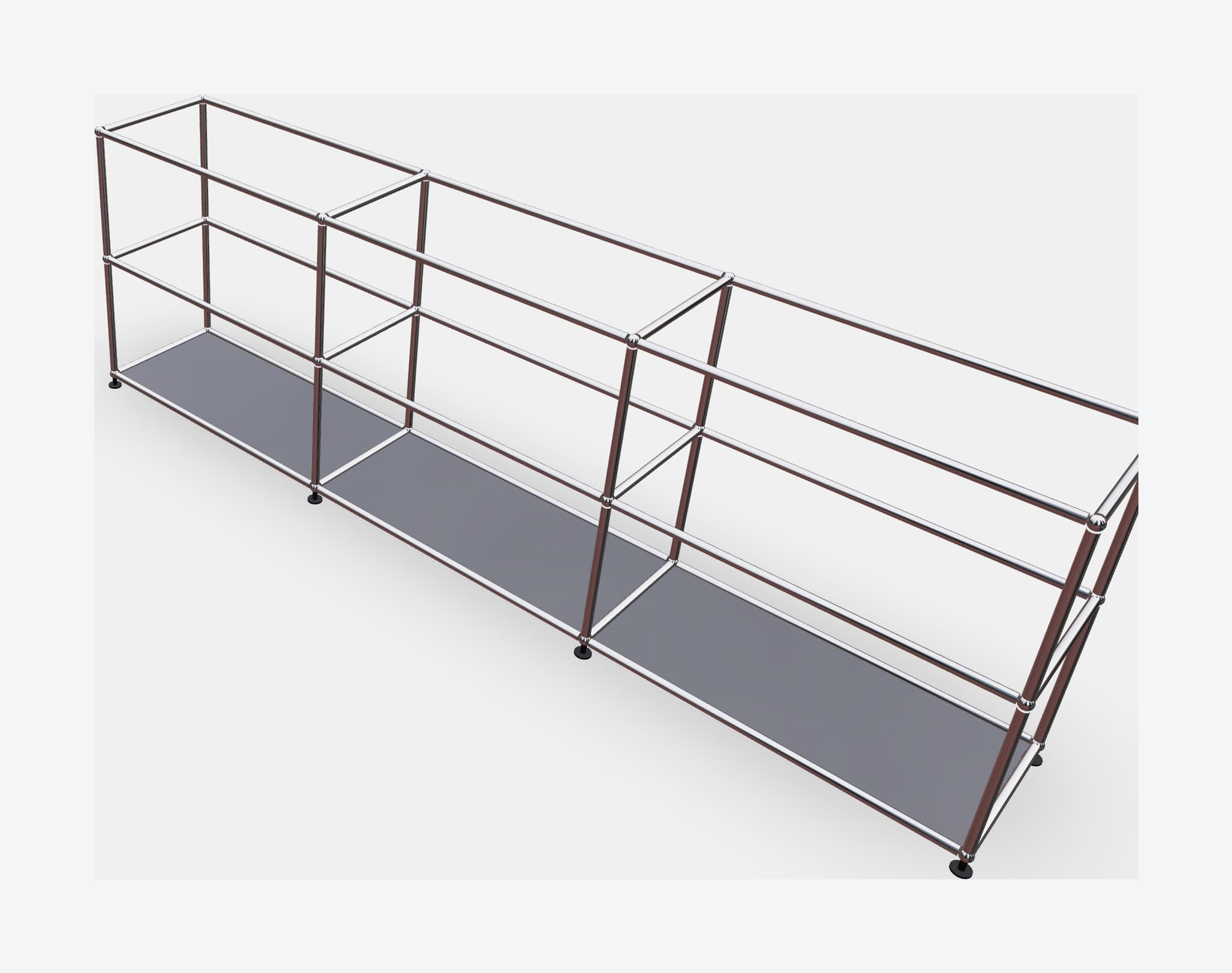
Ready to design your own modular furniture?
Use the free 3D configurator to plan a modular unit from the independent brand Klackjoy — choose size, color, and panels, and verify the exact compatibility requirements for your project.
Design your modular furnitureMade to order. Delivery time varies by destination; duties and taxes are included under DDP.
USM Haller Mixed Color Configurator: Panel-by-Panel Color, Not Just Preset Combos
The problem: standard furniture means one color for everything
Walk into most furniture stores — online or off — and the color decision happens once. You pick "walnut" or "graphite" or "white," and every surface of the piece follows suit. Doors, drawers, side panels, back panels: all the same finish, because the manufacturing and retail systems behind the product were never built to track color at any finer resolution than "the whole item." You choose a SKU, the SKU has a color, and that's the end of the conversation.
USM Haller broke that mold decades ago by making the system itself modular — nodes, tubes, and panels that snap together into an almost unlimited range of layouts, widths, and heights. But even within that modular hardware, the color story has historically stopped at the level of the individual panel type, not the individual panel instance. If you wanted a sideboard with a graphite black carcass and a single ruby red drawer front, you had to know exactly which SKU to order for that one drawer, configure the rest of the piece separately, and hope the retailer's ordering system didn't collapse everything into one color field somewhere along the way. Most configurators — USM's included — are not built around that granularity. They are built around choosing a look once, and then applying it broadly across the whole unit.
This matters more than it might first appear. A sideboard, credenza, or room divider is rarely styled in isolation — it lives next to a rug, a set of chairs, a wall color, artwork on the wall above it. The single-color-per-unit model forces you into one of two compromises: either match everything to the room in a single safe tone (which tends to read as flat and uninteresting), or buy multiple separate units just to introduce variation (which is expensive, and structurally wasteful when a single unit would have done the job perfectly well). The real unlock — the thing that actually changes what's possible with a piece of modular furniture — is being able to treat every visible surface as its own independent design decision. Every door, every drawer front, every side and back panel, chosen the way an interior designer would treat a gallery wall: consistent in its overall logic, but intentionally varied piece by piece.
That is the specific gap Klackjoy's configurator was built to close, and it's why "mixed color" isn't a marketing label here — it describes an actual, different way the underlying system was built.
How Klackjoy's configurator actually enables true panel-by-panel choice
The distinction is architectural, not cosmetic. In Klackjoy's configurator, every panel, door, and drawer you place on a piece carries its own independent color and material assignment. There is no "unit-level" color field that gets applied downstream to every part it touches — each panel stores its own color and material reference directly, the same way it stores its own position and dimensions in the 3D scene. Practically, this shows up in a few concrete ways as you build:
- You can select a door, and only that door, and give it a different material and color than the panel directly next to it — no need to configure a separate module, split the piece into two orders, or duplicate anything.
- Materials mix freely, not just colors. A panel in matte metal, the one beside it in microfiber leather, a third in black oak — each panel's material is set independently of the others, so you're not locked into "all metal" or "all leather" across the whole build the way a single-material product line would force you to be.
- Nothing gets silently overridden as you keep building. Because each panel's color and material live on the panel itself rather than on the unit as a whole, adding a new panel elsewhere or extending the structure doesn't reset your carefully chosen combination back to some default unit color.
- The 3D preview reflects every choice in real time. As you assign colors panel by panel, the canvas updates live, so you can see the actual contrast and balance of the finished piece before you commit to it — not a swatch sheet you have to mentally project onto a photo of furniture that isn't quite your configuration.
This is possible in the first place because the underlying data model was designed around the panel as the atomic unit of customization, not the shelf, the module, or the whole unit. It's a foundational structural choice, not a UI trick layered on top of a system that fundamentally thinks in whole-unit terms — which is also why the mixed-color behavior holds up under everything else the configurator does. The 50-step undo/redo history tracks per-panel changes correctly. The cut-list and bill-of-materials generation reads color and material per panel when it computes what needs to be manufactured. The pricing engine prices each panel's material individually rather than approximating from a single unit-level material guess. None of those systems had to be specially taught to handle mixed-color designs as an edge case, because they were never built around the assumption that a unit only has one color to begin with.
Two honest caveats are worth stating plainly, because we'd rather you know the real boundaries than assume something broader. First, this is structural and material customization within a defined catalog, not an open color-picker with infinite values on demand — the in-configurator palette draws from a real but bounded catalog (16 metal finishes including two metallic options, 19 microfiber leather colors, one wood tone, and two glass finishes). Second, for a color outside that existing catalog, the path is a manual one: you contact us and our team evaluates adding a new hex code to the catalog on the backend. There's no technical whitelist blocking a new color — any valid hex is technically possible once approved — but it is a request-and-review step, not an instant self-serve picker. What is instant and fully self-serve, right now, in the configurator itself, is mixing and matching freely across every color already in the catalog, panel by panel, across every piece you build.
How the granularity actually compares
USM's own configurator does offer a curated "Mix & Match" line, and it's a genuinely useful feature within its scope — but it works from a fixed set of pre-designed color pairings for specific product lines, not free per-panel selection drawn from the full catalog. You're choosing among presets someone else designed, not assigning colors panel by panel yourself. Among the other USM-compatible and replica sellers we checked directly, the granularity ceiling is lower still, and in a couple of cases there's no online configurator to speak of at all. Here's how the four we tested actually break down:
| Configurator | Color/material granularity | What you can actually mix |
|---|---|---|
| Klackjoy | Per panel, door, and drawer | Every individual surface on a piece — mix metal, microfiber leather, wood, and glass finishes freely, panel by panel |
| USM Mix & Match (official) | Fixed preset combinations | A curated set of pre-designed two-tone pairings for specific product lines — not open per-panel selection |
| Konektra | Per unit | One color applies to the entire piece; no variation within a single unit |
| Arvhi | Per module | One color per module or section, but not down to the individual panel within that module |
We say "among USM-compatible/replica sellers" deliberately, because USM's own official configurator's full panel-level behavior outside the dedicated Mix & Match line wasn't something we could exhaustively verify end to end, so we're not claiming Klackjoy is the only panel-level configurator that has ever existed anywhere. What we can say with confidence, based on direct testing, is that among the alternative and USM-compatible sellers we checked, none offer independent color and material control down to each individual panel, door, and drawer the way Klackjoy's configurator does — most stop at the level of the whole unit or, at best, a module within it.
Three styling rules for mixing colors well
Having the freedom to assign a different color to every panel is genuinely powerful — but freedom without a framework tends to produce a busy, uncoordinated piece rather than a striking one. These are general design guidelines we recommend to customers building a multicolor layout, based on patterns we've seen work well across real customer builds — not an official USM rule, and not a limit the configurator itself enforces, just practical advice that tends to hold up well on a modular grid.
1. Cap it at three main colors plus one accent. A sideboard with six different door colors reads as chaotic rather than deliberate, no matter how nice each individual color is. A workable formula that tends to hold up: pick one dominant color for most of the carcass and larger panels, a second supporting color for roughly a third of the surfaces, and reserve a third, bolder color for just one or two accent panels — a single drawer front, one door at eye level. This mirrors the classic 60-30-10 interior design ratio, and it translates cleanly onto a modular grid where every panel is a discrete, countable surface.
2. Use a contrast-ratio guideline, not a strict color-wheel rule. Rather than agonizing over complementary versus analogous color theory, it helps to think in terms of light-to-dark contrast instead. Pair at least one light neutral (Pure White, Light Grey) with at least one genuinely dark tone (Graphite Black, Anthracite) somewhere in the piece — the contrast reads as intentional even when the hues themselves have no formal relationship to each other. A mid-tone-only palette — several greys and beiges with no real light or dark anchor anywhere — tends to look muddy and indecisive rather than deliberately mixed.
3. Let accents follow function, not randomness. The most successful mixed-color builds we've seen put the accent color on a functional highlight — the drawer you open most often, the door positioned at eye level, the section that faces the room's main sightline as you walk in — rather than scattering bold color wherever there happens to be an empty panel. This gives the eye a clear place to land, and makes the color choice look purposeful rather than arbitrary, especially on a wide piece with many panels visible at once.
None of these are hard limits enforced by the configurator itself — you're free to combine any catalog colors in any pattern, on any panel, in any quantity. They're simply patterns that tend to photograph well and live well in a real room over time, based on what we've observed across the builds our customers have actually configured and ordered.
It's worth adding that these guidelines apply equally whether you're mixing colors within a single material — several metal finishes across one sideboard's doors, say — or mixing materials themselves, pairing a metal frame section with microfiber leather drawer fronts and a glass panel elsewhere on the same piece. The panel-level system doesn't distinguish between "changing the color" and "changing the material" as separate operations; both are just properties of that one panel, set independently of every other panel around it. That's what makes it practical to design a piece where the material palette varies as intentionally as the color palette does, rather than treating material as a single fixed decision made once for the whole unit.
Try it yourself
The best way to understand panel-by-panel customization is to see it update in real time, rather than read about it. Open the Klackjoy configurator, add a few doors and drawers to a base frame, and click through them one at a time — you'll notice each panel has its own color and material control, entirely independent of every other panel on the piece. Build a two-tone sideboard, a three-color room divider, or a single accent-drawer credenza, and watch the 3D preview update live as you go, panel by panel. If you want a color that isn't currently in the catalog, reach out to us at support@klackjoy.com or on WhatsApp and our team will evaluate adding it. And because the piece you build stays 1:1 compatible with genuine USM Haller hardware — the same 25mm chrome-plated brass ball connectors, the same stainless steel tubes, the same standard catalog sizing — you get that mix-and-match flexibility at roughly 60-70% less than buying new from USM, direct from the factory.
Frequently Asked Questions
Can I choose a different color for every single panel?
Yes. In Klackjoy's configurator, every panel, door, and drawer you place on a piece carries its own independent color and material assignment. There is no "unit-level" color field that gets applied downstream to every part it touches — each panel stores its own color and material reference directly, the same way it stores its own position and dimensions in the 3D scene. You can select a door, and only that door, and give it a different material and color than the panel directly next to it — no need to configure a separate module, split the piece into two orders, or duplicate anything. Materials mix freely too: a panel in matte metal, the one beside it in microfiber leather, a third in black oak — each panel's material is set independently of the others. The one boundary is that colors come from a defined catalog (16 metal finishes, 19 microfiber leather colors, one wood tone, two glass finishes) rather than an unlimited picker; for a color outside that catalog, you'd contact us for a bespoke addition.
Does USM officially offer mix-and-match?
USM's own configurator does offer a curated "Mix & Match" line, and it's a genuinely useful feature within its scope — but it works from a fixed set of pre-designed color pairings for specific product lines, not free per-panel selection drawn from the full catalog. You're choosing among presets someone else designed, not assigning colors panel by panel yourself. That's different from Klackjoy's approach, where every individual panel, door, and drawer on a piece can be assigned its own color and material independently, rather than choosing from a preset combination. We say this as a factual comparison, not a knock on USM — Mix & Match is a real and useful feature within its own scope, it's simply a narrower one than open per-panel customization.
How many colors can I combine on one piece?
Technically, the configurator doesn't cap the number of colors you can use across a piece's panels — every panel's color is independent, so nothing stops you from assigning a different one to each. That said, we recommend capping it at three main colors plus one accent for a coordinated look: one dominant color for most of the carcass and larger panels, a second supporting color for roughly a third of the surfaces, and a third, bolder color reserved for just one or two accent panels. This is general styling guidance based on what tends to look intentional rather than busy on a modular grid — not an official USM rule or a hard limit enforced by the configurator itself.
Can I mix materials as well as colors on the same piece?
Yes. The panel-level system doesn't distinguish between changing a panel's color and changing its material — both are properties set independently on that one panel, the same way its position and dimensions are. That means you can pair a metal frame section with microfiber leather drawer fronts and a glass panel elsewhere on the very same piece, or run several different metal finishes across one sideboard's doors, without being locked into a single material for the whole build. This mixing works across all four material families in the catalog — metal, microfiber leather, wood, and glass — with each panel choosing independently from whichever finishes are available for its shape and role in the piece.
What if I want a color that isn't in the catalog?
Reach out to us directly — at support@klackjoy.com or over WhatsApp — and our team will evaluate adding a new hex code to the catalog on the backend. There's no technical whitelist blocking a new color; any valid hex is technically possible once it's been reviewed and approved. This is a request-and-review step rather than an instant self-serve picker, so it isn't something you can do inside the configurator on your own in real time — but it means the existing catalog (16 metal finishes, 19 microfiber leather colors, one wood tone, two glass finishes) isn't a hard ceiling on what's possible for your build.
Shop the Klackjoy modular system

Read next
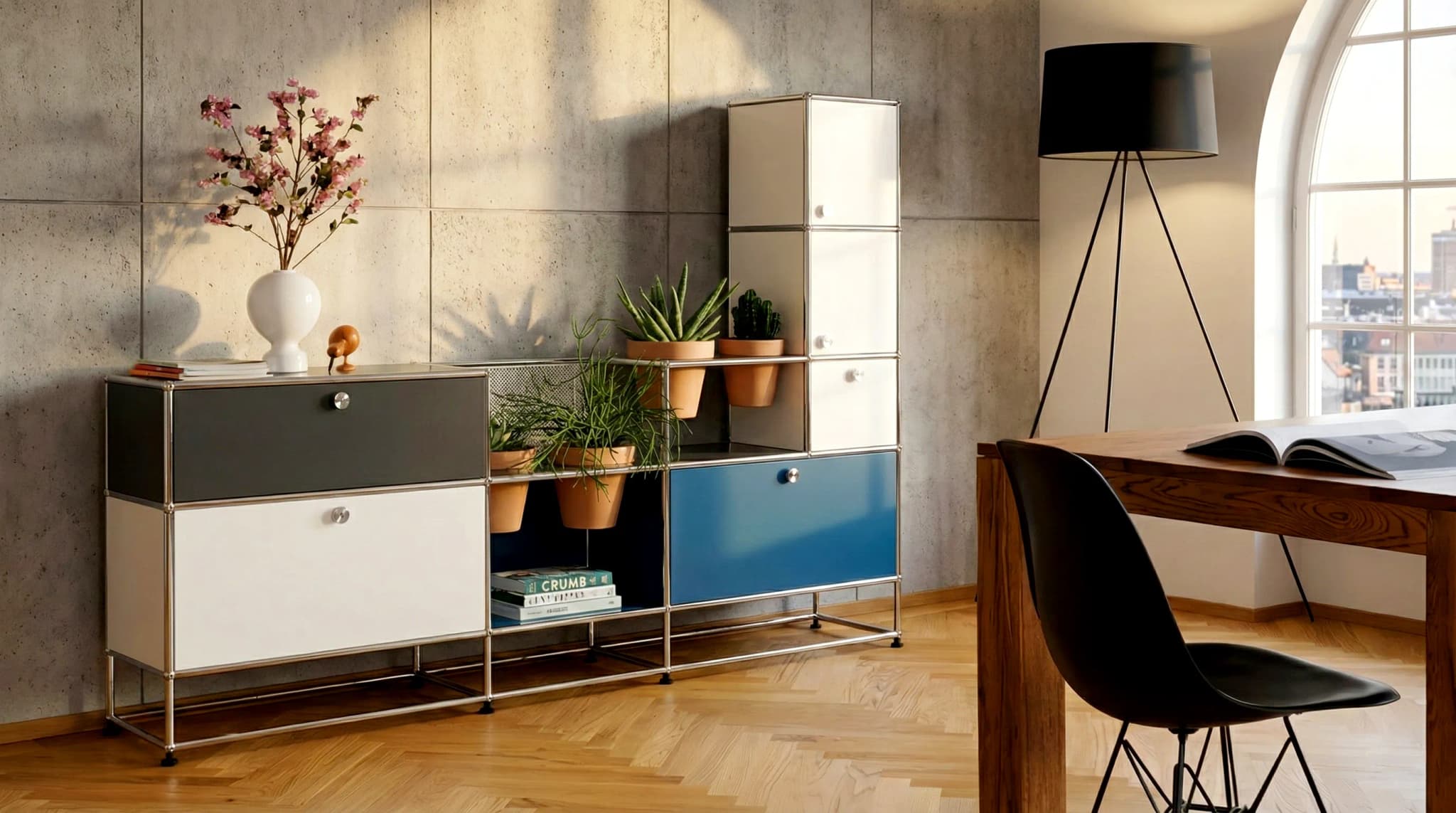 The Complete Guide to USM Haller Colors: Which One Suits Your Space?Explore all 14 USM Haller colors from Pure White to Ruby Red. Learn which colors work best for different rooms and design styles.
- How to Request a Custom Color for Your USM Haller FurnitureWant a color that isn't in the standard palette? Klackjoy's team can evaluate and add bespoke RAL, hex, or leather color requests through a direct consultation — here's exactly how the process works.
Ready to design your own modular furniture?
Use the free 3D configurator to plan a modular unit from the independent brand Klackjoy — choose size, color, and panels, and verify the exact compatibility requirements for your project.
Design your modular furniture