How Our AI Design Wizard Builds Your USM-Style Cabinet
Most people freeze in front of a blank 3D configurator. Klackjoy's AI Design Wizard fixes that by turning a 30-second quiz or a room photo into a real, catalog-accurate cabinet layout — loaded live into the configurator, not a static rendering.
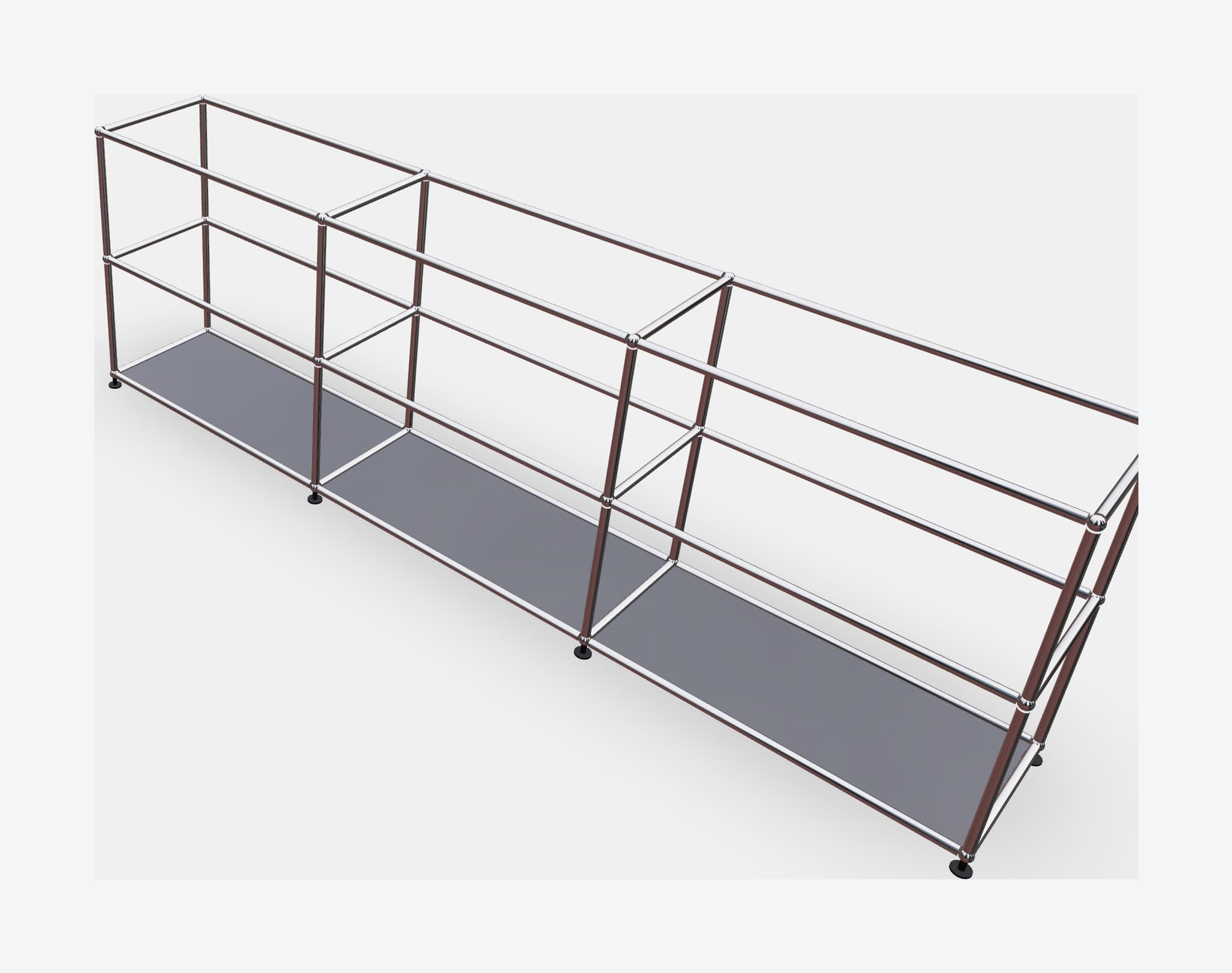
Ready to design your own modular furniture?
Use the free 3D configurator to plan a modular unit from the independent brand Klackjoy — choose size, color, and panels, and verify the exact compatibility requirements for your project.
Design your modular furnitureMade to order. Delivery time varies by destination; duties and taxes are included under DDP.
The blank-canvas problem
Open a 3D furniture configurator for the first time and you're handed an empty grid, a toolbar of unfamiliar icons, and a cursor that doesn't know what it wants yet. For a shape as flexible as USM Haller-style modular storage — where nodes, tubes, and panels can be arranged into nearly any configuration — that freedom is exactly what stalls people. How wide should it be? How many rows? Where do the doors go? Most visitors don't want to learn a 3D tool before they've even decided what they're building.
That's the specific problem our AI Design Wizard is built to solve. It isn't a general-purpose "chat with an AI about furniture" feature, and it isn't a rendering tool that hands you a pretty picture you then have to reverse-engineer into a real order. It's a short, structured input flow — a quiz or a photo — that outputs a real, catalog-accurate cabinet grid and loads it directly into the same 3D configurator every other design on this site is built in. What you get at the end is not a concept. It's a starting design you can keep editing, price immediately, and order.
Meet the AI Design Wizard
You'll find it at /design-wizard, linked from the main navigation. It offers two ways in: a four-step quiz, or a room photo upload. Both are designed to take well under a minute, and both produce the same kind of output — a grid of columns, rows, widths, heights, and depth, built from real USM tube dimensions, ready to view and adjust in 3D.
Mode 1: the four-step quiz
The quiz asks exactly four questions, in this order, plus one optional note:
- Where will it go? — Living room, Study, Entryway, or Office.
- What will it store? — TV, Books, Clothes, or Odds & ends.
- How wide? — Narrow (roughly 1 m), Medium (roughly 1.5 m), or Wide (roughly 2 m).
- Doors or drawers? — Many, Some, or Open shelving.
After those four taps, there's an optional free-text note (up to 200 characters) where you can add anything else — "needs to fit under a window," "want a spot for vinyl records," and so on. That's the entire input. No sign-up wall, no lengthy questionnaire about lifestyle or budget. Four questions and an optional note is enough for the Wizard to generate a sensible starting layout.
Mode 2: upload a room photo
If you'd rather show than tell, you can upload a photo of the room where the piece will live. The Wizard analyzes the image and proposes a layout — a grid sized and shaped to make sense in that space — using the same underlying generation logic as the quiz. This is the faster route if you already know the wall, the alcove, or the space you're filling, and don't want to translate it into "narrow/medium/wide" categories yourself.
What the AI actually decides — and what it doesn't
This is the part we want to be completely transparent about, because it's easy to over-promise with "AI design" language and we'd rather you know precisely what's happening.
The AI Design Wizard generates structure only: the number of columns and rows, the width of each column, the height of each row, and the depth of the unit. Every one of those dimensions is snapped to real USM catalog tube sizes — 100, 150, 175, 250, 350, 395, 500, 595, and 750 mm — the same sizes used throughout the rest of the configurator and the same sizes a physical Klackjoy unit is actually built from. There's no "AI-invented" dimension that doesn't correspond to a real, orderable tube length. Nothing about the generated grid is decorative or approximate; it's a legitimate production-ready structure from the first frame.
What the AI does not decide is color or material. It never selects a panel finish, a metal RAL shade, or a leather tone for you. Every generated layout comes through as an unfinished shell — you choose colors and materials afterward, panel by panel, exactly as you would if you'd built the grid by hand. If you've read about our per-panel color system, that's the same system the Wizard's output plugs straight into.
Door and drawer placement also isn't an AI judgment call — it's a fixed, deterministic rule tied to the density you picked in step 4 (or implied by your photo):
- Open shelving — no doors or drawers anywhere; the whole unit is open.
- Some — doors or drawers only on the bottom row.
- Many — doors or drawers on every row except the top row.
That's it. There's no hidden scoring model weighing "which shelves look better closed." It's a simple, predictable rule, and knowing the rule means you can predict the outcome before you even see it — and adjust it in seconds afterward if it's not quite what you pictured.
What happens after generation
Once the Wizard finishes — whether from the quiz or the photo — the resulting grid loads live into the real 3D configurator. This is not a static image, a PDF mockup, or a separate "preview mode." It's the exact same node/tube/panel data structure that powers every hand-built design on the site. You can rotate it, zoom into it, and immediately start editing: resize a column, add a row, swap a door for open shelving, or start assigning colors and materials panel by panel.
Because the output is the real production spec — not a picture of one — the price updates live as you edit, and when you're happy with it, you check out exactly the way you would with a fully hand-built configuration. There's no export step, no "convert this render into a buildable design" gap to bridge. The Wizard exists to get you to a sensible starting point fast; everything downstream of that point is the same configurator, undo history, pricing, and ordering flow the rest of this site uses.
The quota, honestly stated
AI generation isn't unlimited, and we'd rather tell you the actual numbers than let you find out mid-session. Guests get 1 free generation. Create a free account and you get 5 more on top of that. If you exhaust your quota, or if a generation fails for any reason (a photo that's too dark, an ambiguous room shot, a service hiccup), the Wizard automatically falls back to the closest hand-picked preset design and shows a notice explaining that a fallback was used. You're never left staring at an error with no result at all — worst case, you land on a reasonable pre-built starting layout instead of your custom-generated one, and you can still edit it exactly the same way.
Not the same thing as an "AI room visualizer"
It's worth drawing a clear line between what the Design Wizard does and what a lot of "AI interior design" tools on the market do. Many popular AI room-visualizer apps take a photo or a prompt and generate a rendering — a convincing image of furniture that could go in your room. That's genuinely useful for inspiration, but it stops there: the image isn't built from real dimensions, doesn't correspond to any actual catalog of parts, and can't be ordered. If you like what you see, you still have to go find (or build) the real thing yourself, usually by guessing at sizes.
The Klackjoy AI Design Wizard skips that translation step entirely. Because every generated layout is already built from real USM tube lengths and lands directly in a working configurator, there's no gap between "the AI's suggestion" and "the thing you can actually buy." You're not looking at a picture of a cabinet — you're looking at, and editing, the cabinet's actual buildable structure from the first second.
A quality-of-life feature, not a replacement for choice
We built the Wizard because a lot of people know roughly what they want — "something for the living room, not too wide, mostly closed storage" — but don't want to spend twenty minutes learning grid mechanics before they see anything at all. It's a shortcut past the blank canvas, not a replacement for the configurator itself. Every generated design remains fully editable afterward: add or remove columns and rows, change tube depth, swap door placement, and — most importantly — choose your own colors and materials on every single panel, since that's the one decision the AI deliberately leaves to you.
If you've been putting off starting a design because you weren't sure where to begin, that's precisely the gap this feature closes. Answer four quick questions or upload a photo of the room, see a real dimensioned layout appear in 3D within moments, and take it from there — resizing, recoloring, and refining until it's exactly yours, then ordering it the same way you would any other Klackjoy design.
Ready to see it for yourself? Head to the AI Design Wizard and generate your first layout — it's free, it takes under a minute, and what comes out the other end is a real, orderable USM-compatible cabinet, not a picture of one.
Frequently Asked Questions
Does the AI also recommend colors?
No. The AI Design Wizard generates structure only: the number of columns and rows, the width of each column, the height of each row, and the depth of the unit. Every one of those dimensions is snapped to real USM catalog tube sizes — 100, 150, 175, 250, 350, 395, 500, 595, and 750 mm — the same sizes used throughout the rest of the configurator and the same sizes a physical Klackjoy unit is actually built from. There's no "AI-invented" dimension that doesn't correspond to a real, orderable tube length. Nothing about the generated grid is decorative or approximate; it's a legitimate production-ready structure from the first frame.
What the AI does not decide is color or material. It never selects a panel finish, a metal RAL shade, or a leather tone for you. Every generated layout comes through as an unfinished shell — you choose colors and materials afterward, panel by panel, exactly as you would if you'd built the grid by hand.
What happens if the AI generation fails?
If you exhaust your quota, or if a generation fails for any reason (a photo that's too dark, an ambiguous room shot, a service hiccup), the Wizard automatically falls back to the closest hand-picked preset design and shows a notice explaining that a fallback was used. You're never left staring at an error with no result at all — worst case, you land on a reasonable pre-built starting layout instead of your custom-generated one, and you can still edit it exactly the same way.
How many free AI designs do I get?
Guests get 1 free generation. Create a free account and you get 5 more on top of that.
Can I still customize the result afterward?
Yes. Once the Wizard finishes — whether from the quiz or the photo — the resulting grid loads live into the real 3D configurator. This is not a static image, a PDF mockup, or a separate "preview mode." It's the exact same node/tube/panel data structure that powers every hand-built design on the site. You can rotate it, zoom into it, and immediately start editing: resize a column, add a row, swap a door for open shelving, or start assigning colors and materials panel by panel. Every generated design remains fully editable afterward: add or remove columns and rows, change tube depth, swap door placement, and — most importantly — choose your own colors and materials on every single panel, since that's the one decision the AI deliberately leaves to you.
Shop the Klackjoy modular system

Read next
- USM Haller Room Divider: A Double-Sided Shelf Built to Your Exact OpeningA freestanding, double-sided USM Haller room divider zones an open-plan home while staying accessible from both sides. Klackjoy builds it to your exact width and height in a live 3D configurator.
- Stainless Steel USM Haller Panels: The Made-to-Order GuideUSM Haller frame tubes are stainless steel, but a stainless-steel panel finish is a separate, bespoke option. Here is what stainless panels suit, how they fit, and how to request one from Klackjoy.
Ready to design your own modular furniture?
Use the free 3D configurator to plan a modular unit from the independent brand Klackjoy — choose size, color, and panels, and verify the exact compatibility requirements for your project.
Design your modular furniture