USM Haller 1st vs 2nd Generation: How to Identify and Combine Them
USM Haller has two connector generations — a first-gen three-piece and a current two-piece, switched around 1990. How to identify yours, mix them, and extend an old unit.
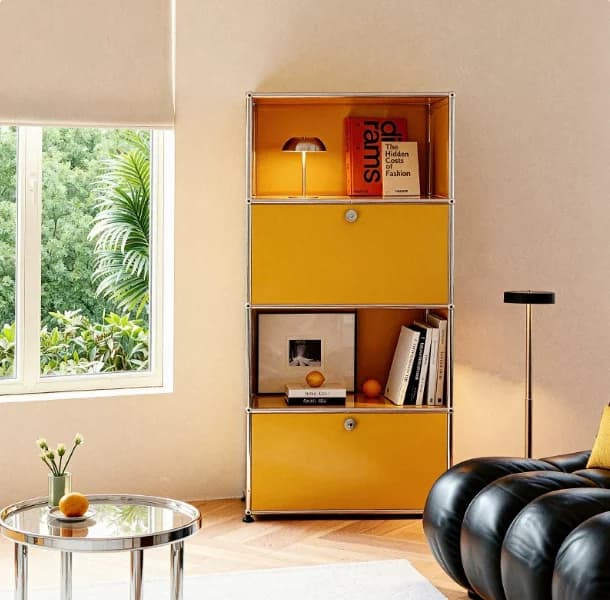
Ready to design your own modular furniture?
Use the free 3D configurator to plan a modular unit from the independent brand Klackjoy — choose size, color, and panels, and verify the exact compatibility requirements for your project.
Design your modular furnitureMade to order. Delivery time varies by destination; duties and taxes are included under DDP.
USM Haller has been made to the same modular grid for decades, but the connector at the heart of the system changed once. Around 1990, the original three-piece connector was replaced by the two-piece connector still in production today. If you own an older unit, are buying second-hand, or want to extend an existing installation, telling the two generations apart is the first thing to get right. This guide shows you how to identify your generation, what actually differs between them, and what that means for mixing, buying used, and adding new parts.
In short: USM Haller has two generations, distinguished by their connector: the first generation uses a three-piece connector, and the second (current) generation, introduced around 1990, uses a two-piece connector. The frame, chrome balls, and tray dimensions are the same across both generations, but the two connector types do not directly plug into each other.
How to tell which generation your USM Haller is
The reliable way to tell which generation your USM Haller is is to look at the connector where a tube meets a chrome ball: the first generation uses a three-piece connector, while the second (current) generation uses a two-piece connector. Age is only a soft hint — the connector is the definitive marker.
Check yours in three steps:
- Find a joint. Pick any point where a tube meets one of the 25 mm chrome balls — that coupling is where the two generations differ.
- Count the pieces in the coupling. A three-piece connector is the original first-generation design; a two-piece connector is the current second-generation design.
- If you are unsure, do not guess. A date around or before 1990 leans first-generation, but batches overlap. Photograph the joint and contact us or a USM specialist before buying parts that depend on the answer.
The two generations compared
The two USM Haller generations differ in exactly one structural way — the connector — while sharing the same dimensions. The first generation uses a three-piece connector; the current second generation, introduced around 1990, uses a two-piece connector. The frame tubes, 25 mm chrome balls, shelves, and trays keep the same sizes across both, so the modular grid is unchanged.
| Feature | First generation | Second generation (current) |
|---|---|---|
| Connector | Three-piece | Two-piece |
| Introduced | Original design | Around 1990 |
| Frame, ball, tray sizes | Same grid | Same grid |
| Connectors interchangeable? | No — not cross-compatible | No — not cross-compatible |
In short, the change was a refinement of the coupling, not a redesign of the system's proportions.
What happens if you mix the two generations
If you mix the two USM Haller generations, the shared dimensions work in your favour but the connectors do not: shelves, trays, and panels sized to the grid are dimensionally interchangeable, yet a first-generation three-piece connector will not directly plug into a second-generation two-piece joint. You cannot simply join an old tube-and-ball connection to a new one.
That distinction matters when you extend a cabinet. Because the frame, ball, and tray dimensions never changed, a shelf or drawer from one era fits the footprint of the other. But the load-bearing connection — the tube-to-ball coupling — is generation-specific, so a new frame section has to be built with connectors that match what you already own. When they do not match, the parts still measure the same; they just will not lock together at the joint. For a deeper look at which components carry over, see our guide to USM Haller compatible parts.
What to check when buying a used USM Haller
When buying a used USM Haller, check the connector generation before you agree a price, because it determines which new parts you can add later. A first-generation piece with three-piece connectors is fully usable on its own, but extending it means sourcing matching first-generation connectors. Confirm the generation, the condition of the chrome balls, and the finish colour.
A quick checklist before you buy second-hand:
- Connector type — three-piece (first generation) or two-piece (current). This decides how easily you can expand later.
- Chrome ball condition — the 25 mm balls are the structural joints; check for pitting or rust.
- Finish colour — note the RAL colour if you plan to match or extend it.
For where to find listings and how to judge condition, see where to buy used USM Haller.
Extending an older USM Haller — your options
To extend an older USM Haller, first confirm your connector generation, then choose parts that match it. If your unit is the current two-piece generation, Klackjoy is built 1:1 to that standard and its parts are physically compatible. If your unit is the first generation with three-piece connectors, the connectors will not directly interplug — contact us first to discuss the options.
Klackjoy is manufactured to the current USM Haller system: the same 25 mm chrome-plated brass ball (M8 thread) and the same standard tube lengths — 100, 150, 175, 250, 350, 395, 500, 595, and 750 mm. That means for a current-generation unit, a Klackjoy section connects on the same grid and extends it seamlessly, at up to 60–70% less than the original and backed by a 10-year structural warranty. If you have a first-generation unit, do not assume the connectors match — the two-piece and three-piece designs do not interplug — so get in touch before ordering. Either way, you can plan the extension in the 3D configurator and see the price update live. If you are weighing whether Klackjoy fits your setup at all, our USM Haller compatibility guide covers it in full. You can also finish the look with matching wood panels or glass doors.
Plan your extension and see your price in the 3D configurator →
Frequently Asked Questions
How do I tell which generation my USM Haller is?
Look at the connector where a tube meets a chrome ball. The first generation of USM Haller uses a three-piece connector, and the second (current) generation uses a two-piece connector. The connector is the definitive marker; age around or before 1990 only hints at the first generation. If you cannot tell, photograph the joint and contact us before buying parts that depend on it.
When did USM Haller change generations?
USM Haller changed from its first-generation three-piece connector to the current two-piece connector around 1990. There is no official exact year; every reliable source describes the switch as happening approximately at that time. The frame, chrome balls, and tray dimensions stayed the same across the change, so only the connector distinguishes the two generations.
Can I mix first- and second-generation USM Haller?
You can mix them dimensionally but not at the connector. Shelves, trays, and panels are sized to the same grid across both generations, so they are interchangeable, but a first-generation three-piece connector does not directly plug into a second-generation two-piece joint. To extend a frame, the new connectors must match the generation you already own.
Are the dimensions the same across USM Haller generations?
Yes. The frame tubes, 25 mm chrome balls, shelves, and trays keep the same dimensions across both USM Haller generations, so the modular grid is unchanged. Only the connector differs: three-piece on the first generation, two-piece on the current one. This is why panels and trays carry over between generations even though the connectors do not interlock.
Does Klackjoy fit my old USM Haller?
Klackjoy is built 1:1 to the current (second-generation) USM Haller system, with the same 25 mm chrome-plated brass connector (M8 thread) and the same standard tube lengths, so it is physically compatible with current-generation units. If your USM Haller is the first generation with three-piece connectors, the two designs do not directly interplug; contact us first so we can confirm the right approach for your unit.
Part of our USM Haller custom panels guide.
Shop the Klackjoy modular system

Read next
- USM Haller Room Divider: A Double-Sided Shelf Built to Your Exact OpeningA freestanding, double-sided USM Haller room divider zones an open-plan home while staying accessible from both sides. Klackjoy builds it to your exact width and height in a live 3D configurator.
- USM Haller Record Stand: A Cheaper Custom Hifi & Vinyl Setup
Ready to design your own modular furniture?
Use the free 3D configurator to plan a modular unit from the independent brand Klackjoy — choose size, color, and panels, and verify the exact compatibility requirements for your project.
Design your modular furniture