USM Haller Weight & Load Capacity: A Practical Guide
How much can a USM Haller unit hold? An honest, qualitative guide to load capacity — tube configuration, panel types, real scenarios, and how to plan a well-supported unit.
Ready to design your own modular furniture?
Use the free 3D configurator to plan a modular unit from the independent brand Klackjoy — choose size, color, and panels, and verify the exact compatibility requirements for your project.
Design your modular furnitureMade to order. Delivery time varies by destination; duties and taxes are included under DDP.
How much can a USM Haller unit hold? It is one of the most common questions before building a shelf, a media unit, or an office storage wall — and the honest answer is that it depends on how the unit is configured, loaded, and supported. USM does not publish a detailed public load table, and figures vary with the exact build, so this guide explains load capacity qualitatively and shows how to plan a unit that comfortably carries what you need. For precise, guaranteed figures, always confirm with USM's official documentation or customer service.
In short: A USM Haller unit's carrying capacity is not a single number — it depends on tube configuration, panel type, how weight is distributed, and how the unit is supported. A standard configuration comfortably handles everyday household loads (books, media devices, tableware, files). For very heavy or densely concentrated loads, add intermediate support and spread the weight. For an exact, guaranteed load rating, consult USM directly — we base this guide on how the system behaves, not on a published capacity table.
How load capacity actually works in USM Haller
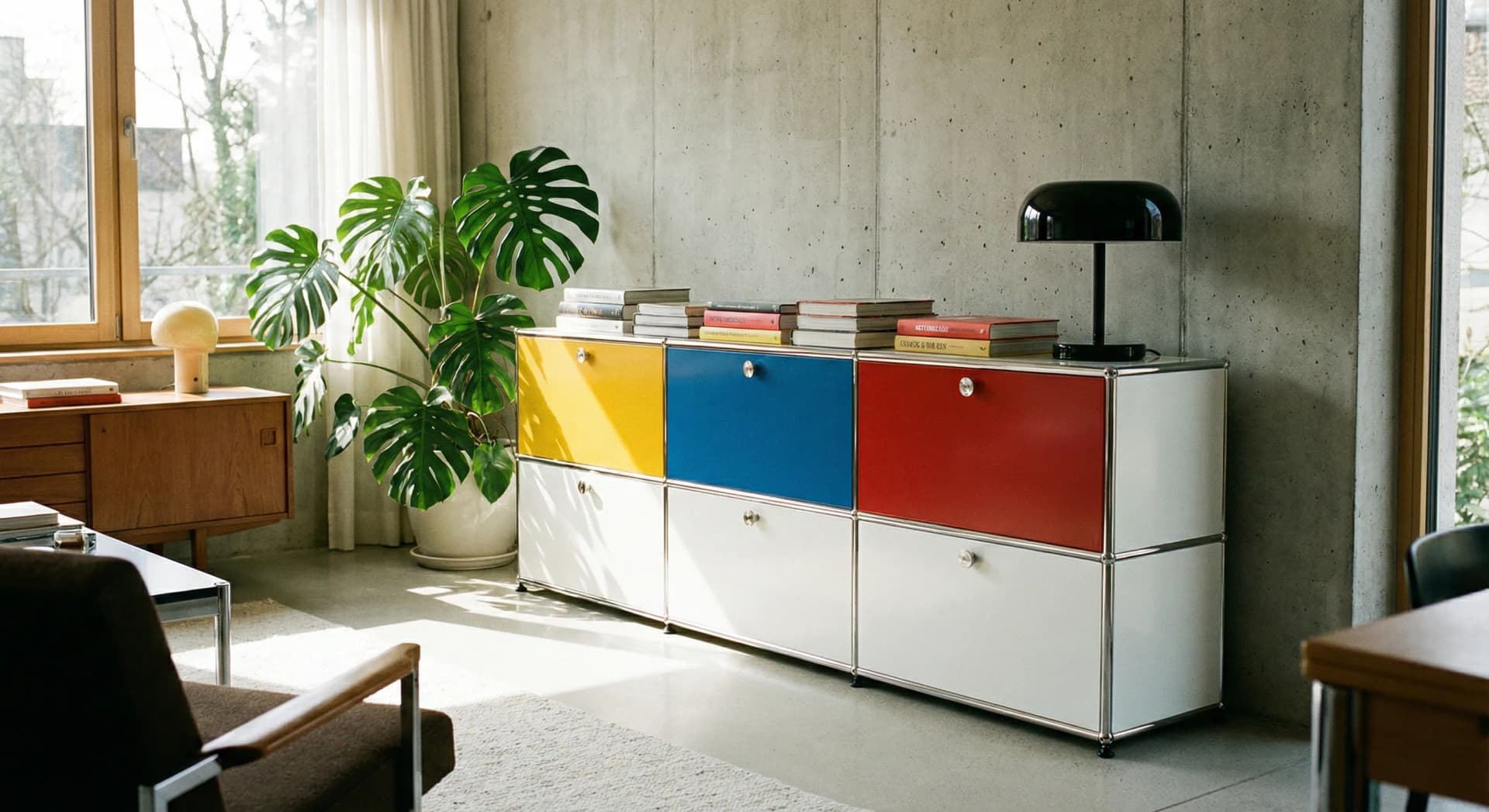
USM Haller is a ball-and-tube steel frame: chrome-plated brass ball connectors (25 mm, M8 thread) joined by steel tubes, closed with powder-coated steel panels. Loads travel from the panels, through the frame of tubes, into the ball connectors and down to the floor. That means capacity is a property of the whole structure, not of any single part — a wide, unsupported span carries less comfortably than the same shelf broken into smaller bays with more vertical support.
Because the load path runs through the frame, the two biggest levers you control are how far a shelf spans between supports and how the weight is distributed across it. A short, well-supported bay is far stiffer than a long, open one, even with identical parts.
Do different tube configurations change capacity?
Yes — qualitatively, configuration matters more than any single dimension. A grid built with shorter horizontal spans and more frequent vertical supports behaves more rigidly and carries concentrated loads more comfortably than a wide, sparsely supported grid. Adding an intermediate vertical division under a long shelf is the single most effective way to increase what that shelf can hold, because it shortens the unsupported span.
We deliberately avoid quoting a specific weight per tube size: USM does not publish per-tube load figures, and the real limit depends on span, support, and distribution together. If you need a guaranteed number for a specific configuration, ask USM.
How panel type affects loading
The panels you choose change both the usable load surface and the character of the unit:
- Steel shelves and tops are the structural, load-bearing surfaces — this is what you place books, devices, and storage on.
- Metal doors and drop-down fronts enclose a compartment; they are designed to carry their own operation, not to be stood on or hung with heavy external loads.
- Glass doors and glass shelves are primarily for display and lighter items; treat them conservatively and avoid concentrated or impact loads.
- Wood or laminate tops are often used as desk or surface elements; they add a warmer surface but should still be loaded within sensible everyday limits.
As a rule, put the heaviest items on steel shelves that sit directly on the frame, and keep glass and door elements for lighter, display-oriented use.
Common scenarios — a practical reference
These are qualitative planning guides, not guaranteed ratings:
- Books, densely packed: Bookshelves are one of the heaviest everyday loads because weight is continuous along the whole shelf. For a library-style wall of tightly packed books, keep horizontal spans shorter and add intermediate vertical supports rather than relying on one long open shelf.
- TV and media equipment: A television plus a receiver, console, and cabling is a moderate, fairly concentrated load. A standard media configuration handles this comfortably; centre heavy devices over supported points rather than at the middle of a long, unsupported span.
- Office and files: Dense paper files and full drawers are deceptively heavy. For filing use, favour smaller bays, place heavy drawers low in the unit for stability, and avoid loading everything at the top.
In every case, the goal is the same: shorten spans, add support under heavy zones, and spread rather than concentrate the weight.
How to optimise a unit for heavier loads
- Shorten the span: Break a long shelf into smaller bays with additional vertical tubes and connectors.
- Add intermediate support: A vertical division under the middle of a heavily loaded shelf dramatically increases what it can hold.
- Distribute weight: Spread heavy items along a shelf and across the unit instead of concentrating them in one spot.
- Load low for stability: Keep the heaviest items near the base so the whole unit stays stable and less top-heavy.
- Use steel shelves for the heavy work: Reserve glass and doors for lighter, display items.
Warning signs of overloading
Stop and redistribute the load if you notice any of these:
- Visible bowing or sagging of a shelf under load.
- The unit feeling wobbly, racking (leaning) sideways, or unstable.
- Doors or drawers that no longer align or close cleanly.
- Any flexing or movement at the connectors.
If you see these signs, remove weight, shorten the loaded span, or add support — and if in doubt about a specific configuration, contact USM to confirm safe limits.
Klackjoy: the same structure, planned the same way
Klackjoy is physically 1:1 compatible with genuine USM Haller — the same 25 mm chrome-plated brass ball connector (M8) and the same standard tube lengths (100, 150, 175, 250, 350, 395, 500, 595 and 750 mm) with powder-coated steel panels — so it behaves the same way structurally and is planned for loads the same way: shorten spans, add support, distribute weight. You can build a new unit in the 3D configurator or extend an existing USM installation, at 60–70% less than new USM and with a 10-year structural warranty. As with USM, for an exact guaranteed load figure on a specific build, ask us and we'll help you plan a configuration with the right support.
Plan a well-supported unit in the 3D configurator →
Frequently Asked Questions
How much weight can a USM Haller shelf hold?
There is no single figure, because a USM Haller shelf's capacity depends on how far it spans between supports, how the weight is distributed, and which panel type you use. USM does not publish a detailed public load table, so we describe capacity qualitatively rather than quoting a specific number. In practice a standard, well-supported steel shelf comfortably carries everyday household loads; for heavy or densely packed items, shorten the span and add support. For an exact, guaranteed rating on a specific configuration, confirm with USM's official documentation or customer service.
Can a USM Haller unit hold a lot of books?
Yes, but books are one of the heaviest everyday loads because the weight is continuous along the whole shelf. For a densely packed, library-style wall, keep horizontal spans shorter and add intermediate vertical supports instead of relying on one long open shelf. Distribute the weight and place heavier volumes lower in the unit for stability. We avoid quoting a specific kilogram figure because USM does not publish one — for a guaranteed capacity, ask USM directly.
Is USM Haller strong enough for a TV and media equipment?
A television with a receiver, console, and cabling is a moderate, fairly concentrated load that a standard USM Haller media configuration handles comfortably. Centre heavy devices over supported points rather than in the middle of a long, unsupported shelf, and keep the heaviest components lower for stability. For an exact guaranteed rating on your specific build, confirm with USM, since precise load figures are not publicly published.
How can I increase the load capacity of a USM unit?
The most effective step is to shorten the span: break a long shelf into smaller bays with additional vertical tubes and connectors, and add an intermediate support under any heavily loaded shelf. Distribute weight along the shelf instead of concentrating it, load the heaviest items low for stability, and reserve steel shelves for the heavy work while keeping glass and doors for lighter display items. These structural steps matter more than any single tube dimension.
Does USM publish an official weight capacity table?
USM does not publish a detailed public per-part load table, and precise capacity depends on the exact configuration, support, and load distribution. For that reason we describe load behaviour qualitatively and recommend confirming any exact, guaranteed figure with USM's official documentation or customer service before planning a very heavy load. Klackjoy, being physically 1:1 compatible with USM, behaves the same way structurally and is planned for loads using the same principles.
Shop the Klackjoy modular system
Read next
- Buying Modular Steel Furniture from the Factory: Foshan Manufacturing, DDP Shipping vs Dropshipper PitfallsConsidering sourcing modular ball-and-tube steel furniture directly from China? Learn the manufacturing realities of Foshan metal fabrication, avoid sea-freight port fee traps, and understand engineering standards.
- The Ultimate Guide to Modular Steel TV Consoles: Cable Management, Heat Dissipation & ErgonomicsHow to configure a modular steel media console for large screens: hidden cable pass-throughs, perforated ventilation for gaming consoles, and viewing height planning.
Ready to design your own modular furniture?
Use the free 3D configurator to plan a modular unit from the independent brand Klackjoy — choose size, color, and panels, and verify the exact compatibility requirements for your project.
Design your modular furniture