The History of Modular Furniture: From Bauhaus to USM Haller
Explore the fascinating history of modular furniture from Bauhaus to USM Haller. Learn how design innovation created timeless furniture systems.
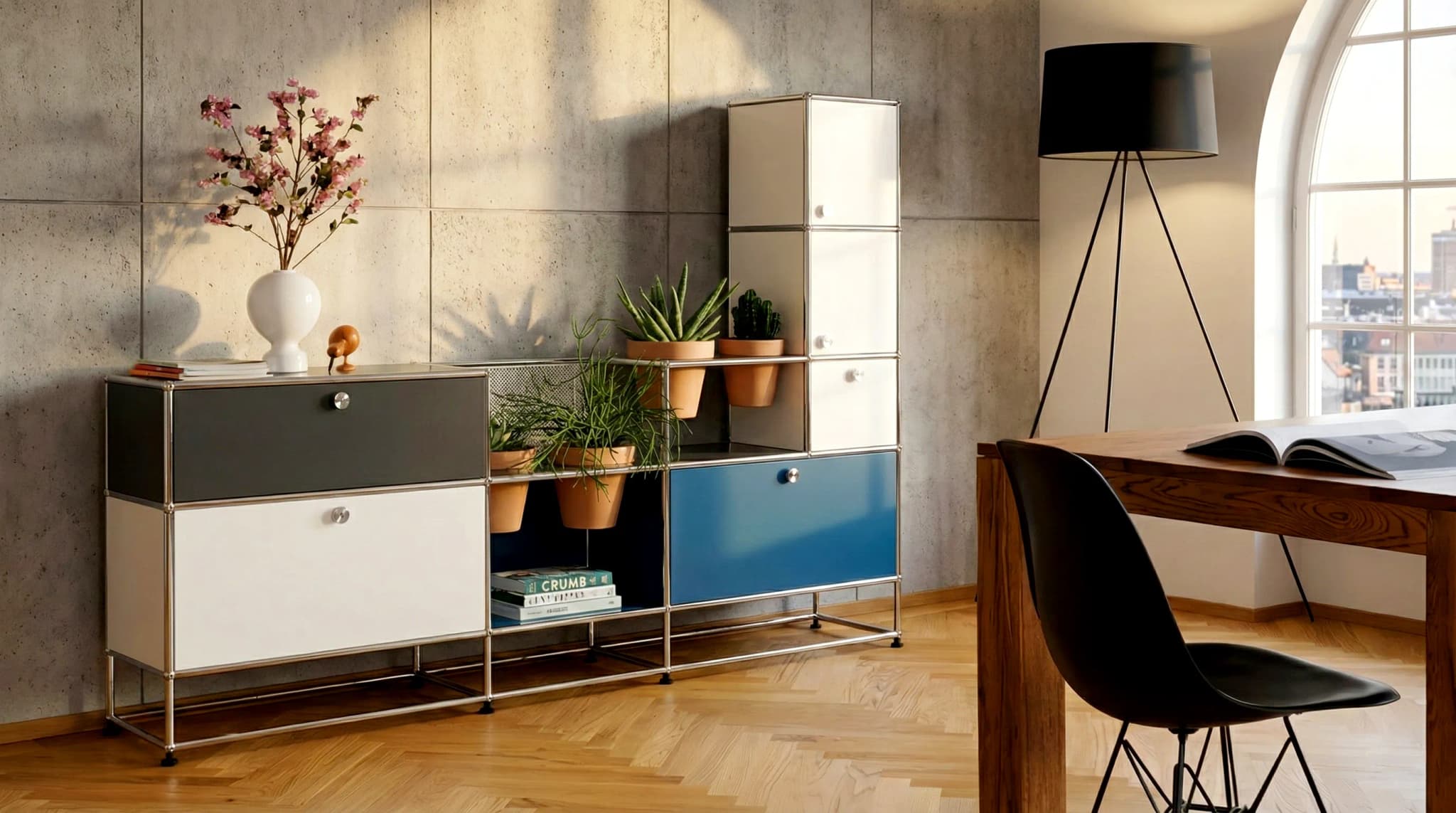
Modular furniture didn't appear overnight. It evolved through a century of design innovation, industrial advancement, and cultural change. Understanding this history helps appreciate why systems like USM Haller became design icons—and why they remain relevant today.
The Roots: Early 20th Century
The Bauhaus Influence (1919-1933)
The story begins at the Bauhaus school in Germany. Founder Walter Gropius championed the idea that form should follow function and that good design should be accessible to all.
Key Bauhaus principles that shaped modular furniture:
- Standardization — Interchangeable parts reduce cost and complexity
- Industrial materials — Steel, glass, and manufactured components
- Geometric simplicity — Clean lines over ornament
- Democratic design — Quality for the masses, not just the elite
Marcel Breuer's tubular steel chairs (1925-1926) demonstrated that industrial materials could be elegant, paving the way for steel-based modular systems.
The Rise of Systems Thinking (1940s-1950s)
Post-War Innovation
World War II accelerated industrial production techniques. After the war, designers applied these innovations to furniture:
Charles and Ray Eames (USA)
- Explored modular storage systems (ESU - Eames Storage Units, 1950)
- Combined steel frames with colorful panels
- Influenced generations of modular designers
Le Corbusier (France/Switzerland)
- Developed the "Modulor" — a human-scale measuring system
- Applied mathematical ratios to furniture proportions
- Emphasized standardized, reproducible components
The Birth of USM Haller (1963)
Fritz Haller's Vision
Swiss architect Paul Schärer asked Fritz Haller to design furniture for the expanding USM factory in Münsingen, Switzerland. Haller's response was revolutionary:
The Innovation: Instead of designing fixed furniture, Haller created a construction system:
- Chrome-plated brass ball connectors with six threaded holes
- Steel tubes in standardized lengths (350mm, 500mm, 750mm)
- Powder-coated steel panels that slot into the framework
Why It Worked:
- Infinite configurations from limited components
- No tools required beyond an Allen key
- Could be assembled, disassembled, and reconfigured indefinitely
- Professional aesthetics suitable for office and home
Early Adoption
USM Haller first appeared in:
- Corporate offices (Rothschild Bank, Paris, 1969)
- Design studios and architectural firms
- Museums (Centre Pompidou, Paris, 1977)
The system's presence in prestigious settings established it as a design status symbol.
The 1970s-1980s: Global Expansion
From Switzerland to the World
USM expanded internationally, with the furniture appearing in:
- Germany: Corporate headquarters of major companies
- USA: Design-forward offices in New York and California
- Japan: Embraced for its minimalist aesthetic
Design Recognition
Major museums acquired USM Haller for their permanent collections:
- MoMA (New York)
- Centre Pompidou (Paris)
- V&A (London)
This museum recognition cemented USM Haller's status as "design art."
The 1990s-2000s: Digital Age Adaptation
New Work Environments
The rise of personal computing and later, the internet, transformed workplaces. USM Haller adapted:
- Cable management solutions for electronics
- Computer-age configurations (monitor shelves, keyboard trays)
- Home office applications as remote work emerged
Color Expansion
Originally available in limited colors, USM expanded to 14 powder-coated options, allowing greater personalization.
The 2010s: Sustainability Recognition
Lifetime Value
As sustainability became paramount, USM Haller's durability gained new appreciation:
- 50+ year lifespan vs. 5-10 year disposable furniture
- 100% recyclable steel and brass components
- Circular economy — used USM commands strong resale value
- No planned obsolescence — same components fit old and new
Second-hand Market
A robust market for vintage USM Haller emerged, with some configurations appreciating in value.
The 2020s: Accessible Alternatives
The Compatibility Era
Recognizing that USM Haller's price point excluded many design enthusiasts, compatible alternatives emerged:
Klackjoy and similar systems offer:
- Identical 750 × 350 × 350mm grid dimensions
- Same ball-and-tube construction principle
- Measured 1:1 fit at the documented 25 mm M8 connector interface
- Significantly lower price points
This democratization echoes the original Bauhaus ideal: good design accessible to all.
Why Modular Endures
Timeless for a Reason
Modular furniture like USM Haller has outlasted countless trends because:
| Factor | Traditional Furniture | Modular Systems |
|---|---|---|
| Style lifespan | 5-15 years | 50+ years |
| Adaptability | None | Infinite |
| Sustainability | Often landfill | Fully recyclable |
| Value retention | Depreciates | Maintains/appreciates |
The Future
Modular thinking now extends beyond furniture:
- Modular electronics (Framework laptops)
- Modular architecture (prefab buildings)
- Modular software (microservices)
The principles Fritz Haller applied to furniture are now universal design philosophy.
Ready to join this design legacy? Explore the Configurator and create your own chapter in modular history.
Related Articles:
Frequently Asked Questions
When did modular furniture first begin?
Modular furniture has its roots in the German Bauhaus school of the 1920s, where designers championed standardized, interchangeable parts, industrial materials and clean geometric forms. Marcel Breuer's tubular steel chairs of 1925-1926 proved industrial materials could be elegant. These ideas matured into true modular systems after World War II and culminated in USM Haller in 1963.
Who designed USM Haller and in what year?
USM Haller was designed by Swiss architect Fritz Haller and introduced in 1963. He created it for the USM factory in Münsingen, Switzerland, at the request of Paul Schärer. Rather than fixed furniture, Haller designed a construction system of connectors, steel tubes and panels that could be assembled and reconfigured into almost limitless layouts.
What makes USM Haller a modular system rather than ordinary furniture?
USM Haller is modular because it is built from a small kit of repeating parts instead of fixed pieces. A 25mm chrome-plated brass ball connector with an M8 thread links steel tubes in standard lengths, and powder-coated panels slot into the resulting frame. The same components can be assembled, taken apart and reconfigured endlessly, so one system adapts to changing needs.
Why has modular furniture stayed popular for so long?
Modular furniture endures because it adapts instead of becoming obsolete. A USM Haller-style system can be reconfigured as your space and needs change, lasts for decades, holds resale value and avoids the throwaway cycle of fixed furniture. This combination of longevity, flexibility and timeless geometric design keeps it relevant across shifting trends and interior styles.
How do modern compatible systems like Klackjoy relate to the original USM Haller?
Modern systems like Klackjoy use the same ball-and-tube construction principle as USM Haller and are built to be physically 1:1 compatible, so parts mix and extend existing USM units directly. The key difference is price: Klackjoy is factory-direct and roughly 60-70% cheaper, with a live 3D configurator and a 10-year structural warranty, making this design language far more accessible.
Shop the Klackjoy modular system

Read next
- USM Haller Record Stand: A Cheaper Custom Hifi & Vinyl Setup
- Stainless Steel USM Haller Panels: The Made-to-Order GuideUSM Haller frame tubes are stainless steel, but a stainless-steel panel finish is a separate, bespoke option. Here is what stainless panels suit, how they fit, and how to request one from Klackjoy.
Ready to design your own modular furniture?
Use the free 3D configurator to plan a modular unit from the independent brand Klackjoy — choose size, color, and panels, and verify the exact compatibility requirements for your project.
Design your modular furniture